Mike Hetrick
Director, Product Marketing
Connect with us

Enterprise AI agents can produce conflicting answers when business definitions are fragmented across warehouses, BI tools, and metadata systems. Learn how MetaKarta resolves governed context at compile time to improve answer consistency and reduce runtime costs.
The pilot worked. The agent answered questions about revenue, someone important saw the demo, and the project got funded.
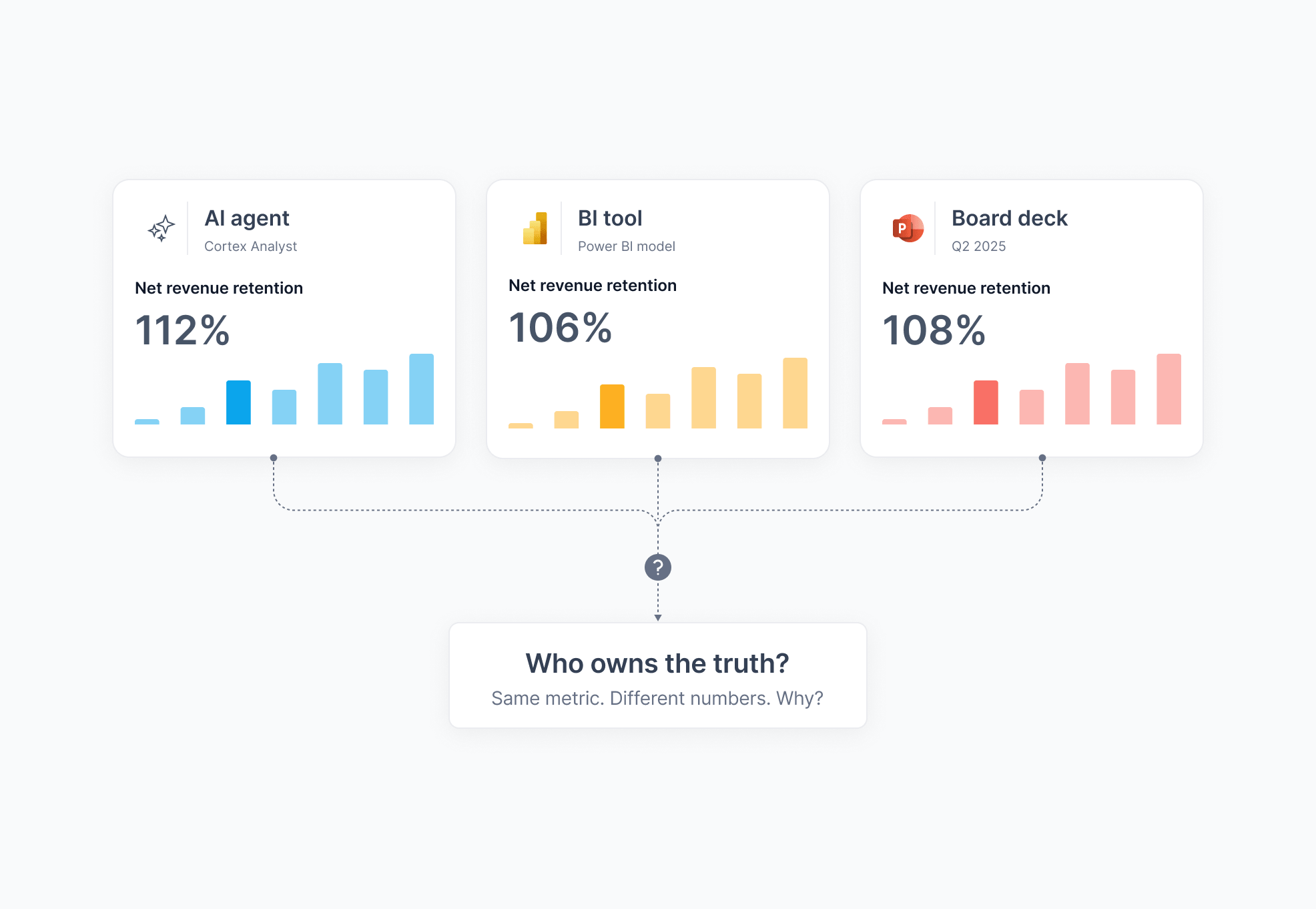
Then it hit production data. The agent said Q3 revenue was $41.2M. The Power BI dashboard said $39.8M. Both numbers came from the same warehouse.
The postmortem blamed the model. Wrong suspect. The model did exactly what it was asked to do: infer meaning from raw schema. The schema just doesn't agree with itself, because your systems were built independently, by different teams, in different years, with different definitions of "revenue."
Hallucination in enterprise AI is mostly a metadata problem.
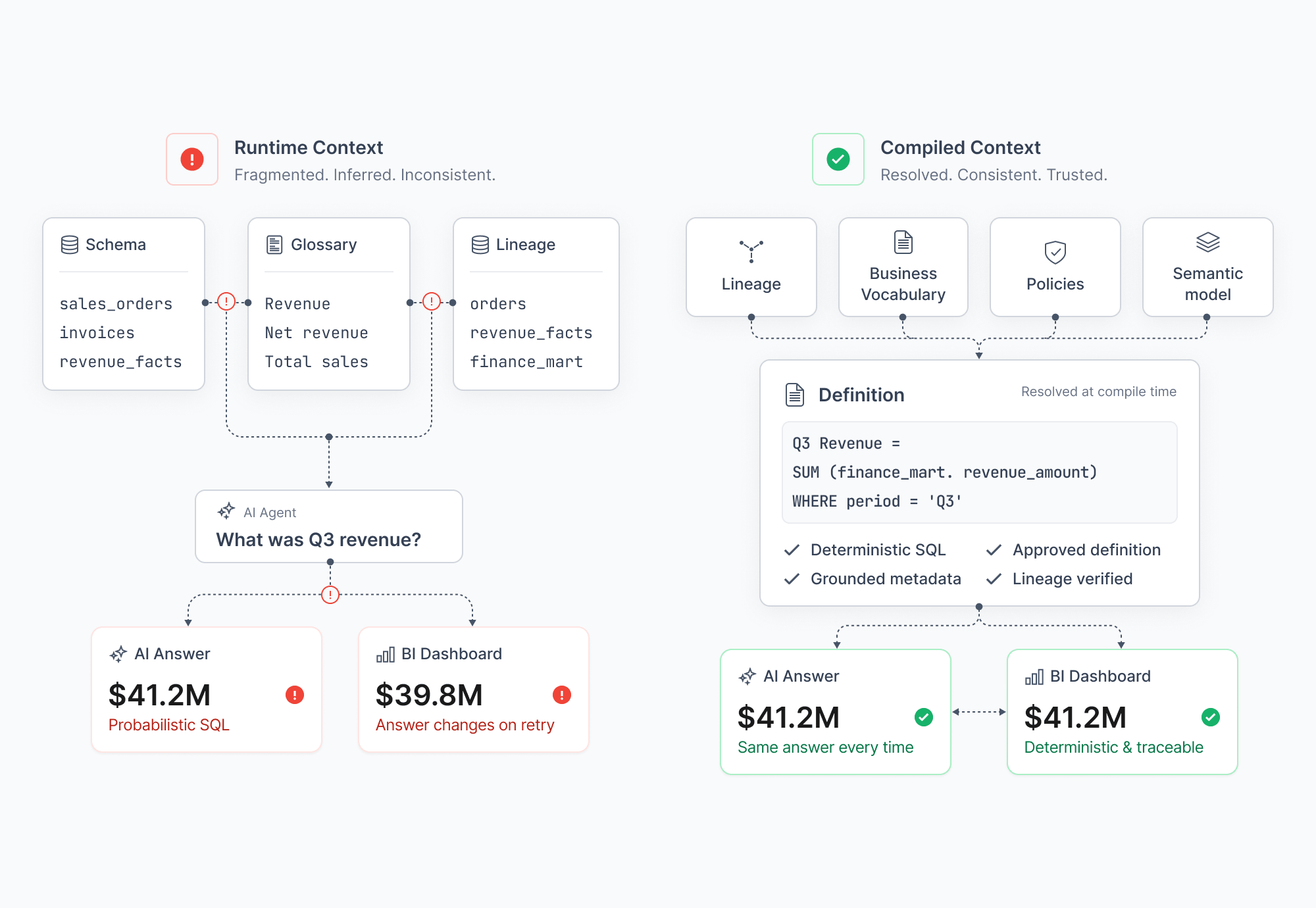
Here's the pattern behind most stalled AI initiatives. The agent gets handed raw context: schemas, glossary entries, lineage records, sometimes a graph connecting them. Then it's expected to assemble meaning at runtime, every time, for every question.
That architecture sends you two invoices.
The first invoice is quality. The agent picks whichever definition sits nearest, generates SQL probabilistically, and returns an answer that might be right. When it's wrong, someone iterates: rephrase the question, correct the context, run it again. Trial and error at machine speed is still trial and error. You've automated the guessing.
The second invoice is money. Assembling context at runtime costs compute: every question means walking the graph, correlating glossary entries against schemas, fishing for what a metric means. Generating SQL costs tokens. Regenerating it when the answer's wrong costs more tokens. The bill scales with every question asked, and the vendor serving the raw context isn't the one paying it. You are.
The two invoices have one root cause: nothing was resolved before the question arrived.
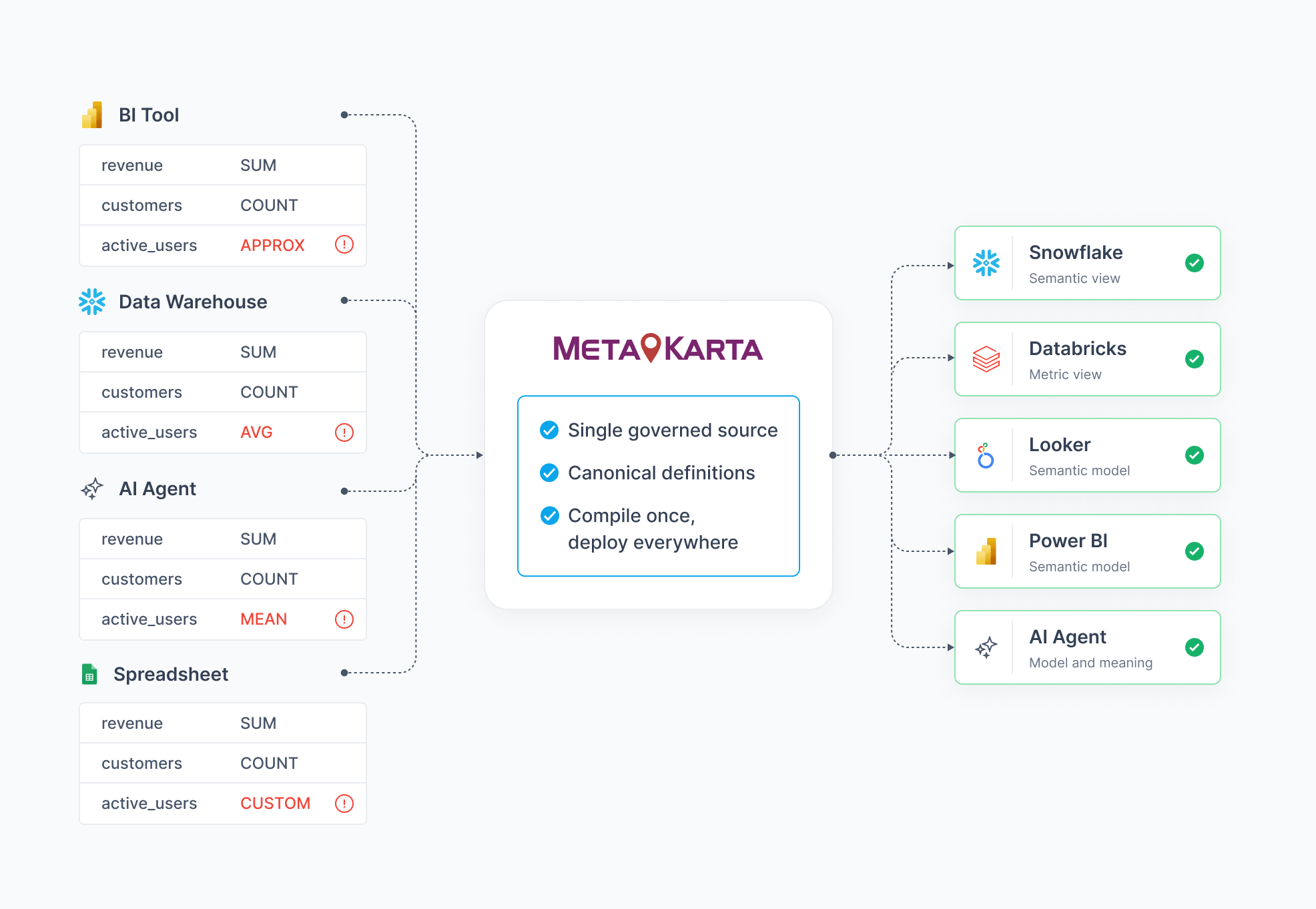
The frustrating part is that your organization already knows what revenue means. Finance defined it. The definition lives in a Power BI semantic model, and a slightly different version lives in Tableau, and a third lives in a dbt model someone wrote during the migration.
Data teams spend more time reconciling definitions across tools than building anything new. The same fragmentation that made your BI tools disagree is now feeding your agents. AI didn't create the problem. It removed the human who used to absorb it.
Flip the sequence. Govern the definition once, with a human approving it. Wire the business vocabulary directly to the metric that implements it. Compile the whole thing into the systems that answer questions, before any question arrives.
Now the agent's job changes. It reads context that was already resolved: the approved definition, its vocabulary, its bindings to real tables and columns, with lineage from source to output. It returns a deterministic query. There's no graph to walk at runtime, no meaning to assemble, no second attempt.
The quality invoice shrinks because the agent stops guessing. The cost invoice shrinks because the expensive work happened once, at compile time, instead of on every question.
Metadata maturity matters here. It's whether meaning gets resolved before the query or during it.
Ask your current vendors one question: when my agent answers, what did it cost to assemble the context, and can I see how the answer was grounded?
If the honest answer involves runtime graph traversal and a token bill, you've found your two invoices.
MetaKarta resolves context at compile time. Governed definitions, business vocabulary wired in, compiled into your databases and BI tools, served to agents as curated context through MetaKarta MCP. Same answer across AI and BI.
Get in touch to learn more about how MetaKarta delivers compiled context to your AI agents, BI tools, and databases.