


400+
Native connectors
Every claim about grounding an agent, defending a number, or answering an auditor rests on the same foundation: whether the metadata describing your estate is complete, deep, derived, current, and governed.
MetadataOps is the discipline of running your metadata estate as an operated system, and the role that owns it. Build your practice by combining people, process, and technology.

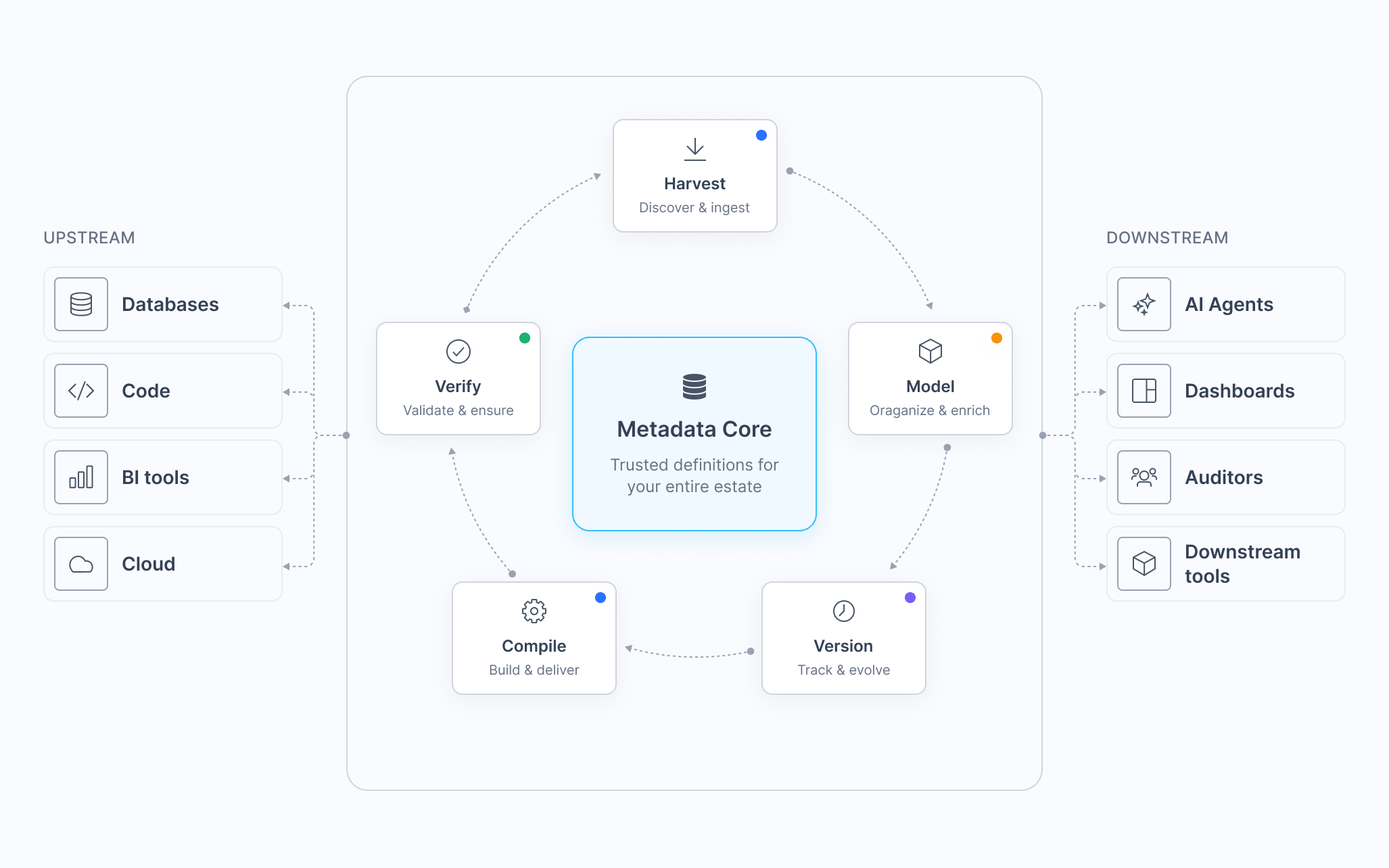
A data engineer moves the data. A MetadataOps engineer owns what it means, everywhere it lands.
The work sits between data engineering, data governance, and AI platform engineering, and it borrows its operating discipline from all three. There's a build, a test, a deploy, a diff, and a rollback.
MetadataOps is the supply side. Context engineering is what happens to that supply at the moment an agent asks.
Decides what exists to be retrieved. Metadata harvested across the estate, modeled into owned definitions, versioned, and governed, so there is something trustworthy to assemble from.
Decides which of it reaches an agent's window. Which definitions, which policies, which lineage, in what order, under what token budget. It can only reach what the supply side already collected.
Each stage depends on the one before it. Skip one and the failure surfaces downstream, as a number two teams can't reconcile or an agent answer that can't be traced to its source.


These five describe the metadata, never the data values. Bad values, null rates, data recency, and pipeline reliability belong to data quality tooling and data engineering. A strong score says the estate is well described. It says nothing about whether last night's load was correct.
0 to 6
Metadata is documentation. It supports discovery and human judgment. Agents produce confident answers with no way to check them.
7 to 12
The modern slice is in reasonable shape and the edges are dark. Agents are right about the covered path and wrong in ways that are hard to predict.
13 to 16
You can answer where a number came from across most of the estate, with named exceptions. The first band where grounding claims survive a motivated technical challenge.
17 to 20
The estate runs as a system. An agent grounds on a governed definition, and an auditor gets a query result on demand.
MetaKarta is a metadata management platform built on a shared metadata repository, with 400+ native connectors, parser-based column-level lineage, and full version and configuration management of the metadata estate across dev, test, and production.
The five dimensions above describe what the practice requires. The platform is how we built for it.
Native connectors
OEM metadata expertise