For Analytics Engineers and BI Leads

Make your semantic models outlast the next BI migration

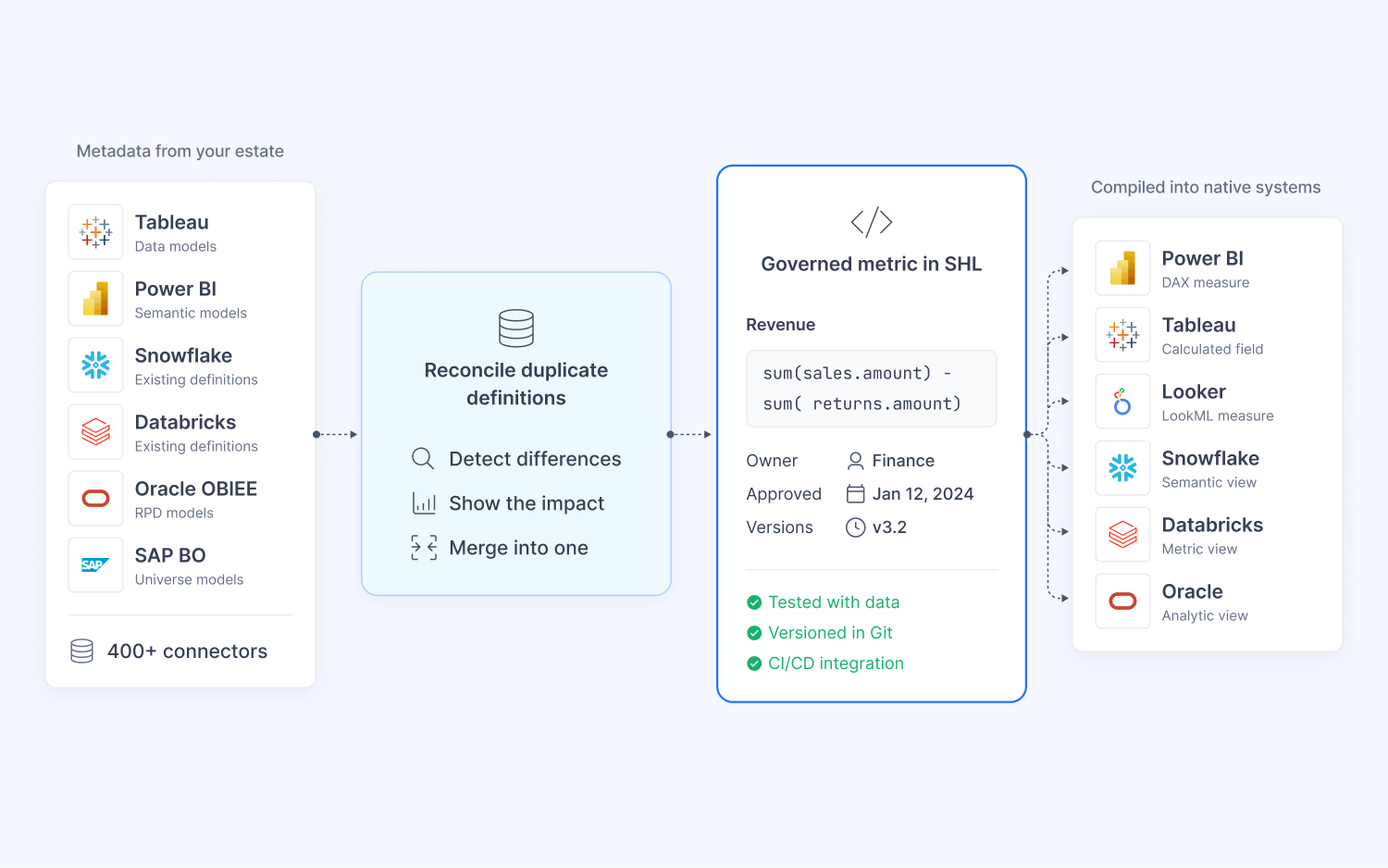
MetaKarta imports the semantic models you've already built, reconciles duplicate definitions into one governed version, and compiles it into every BI tool and warehouse you run. Import what you have, model what you need, compile it everywhere.

Key capabilities

Reverse-engineer Power BI, Tableau, and legacy BI semantic models

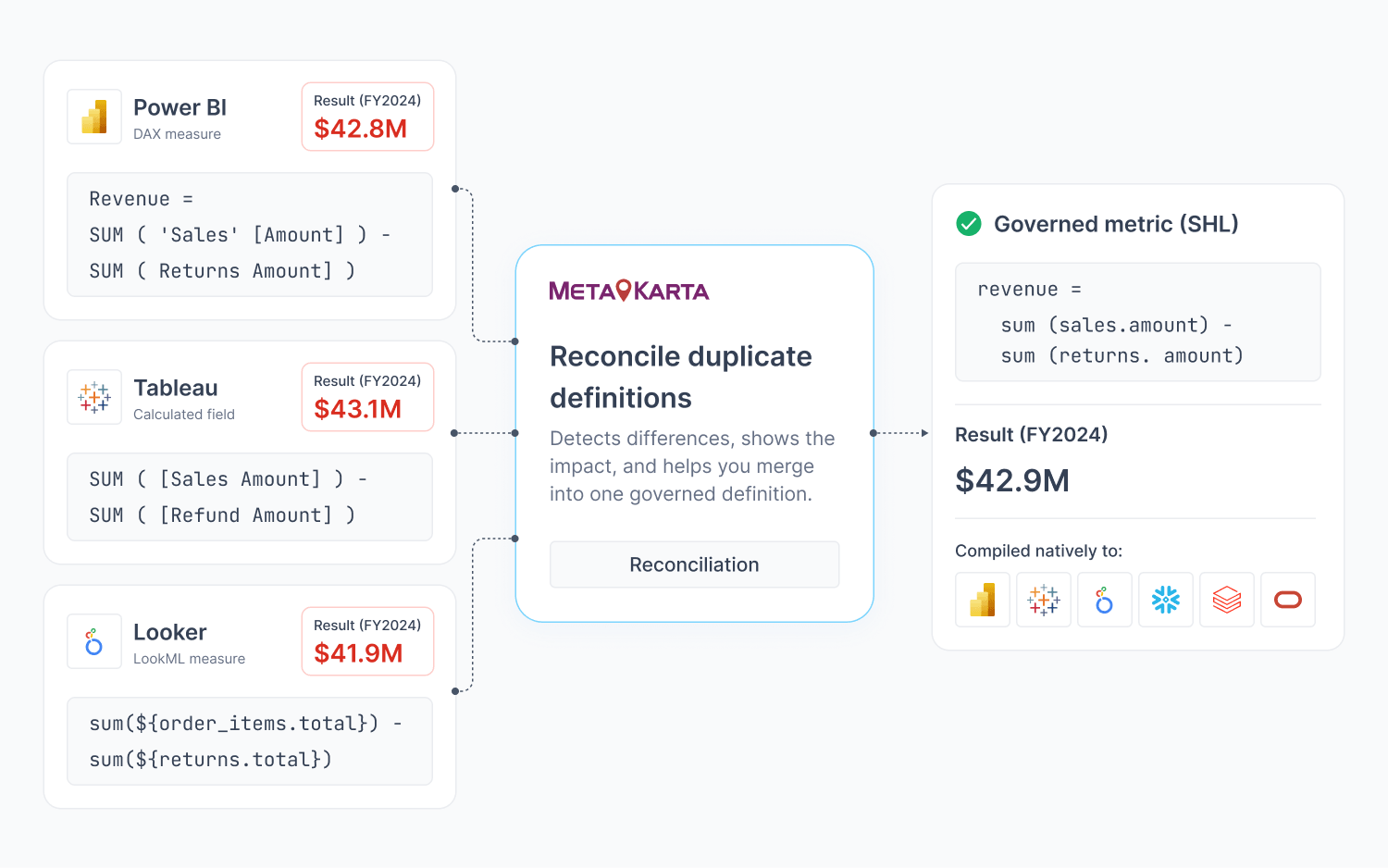
Reconcile duplicate metric definitions into one

Compile natively to six BI and warehouse targets

Definitions in Semantic Hub Language (SHL), versioned in Git with CI/CD

The Problem

Every BI tool wants its own copy of the metric

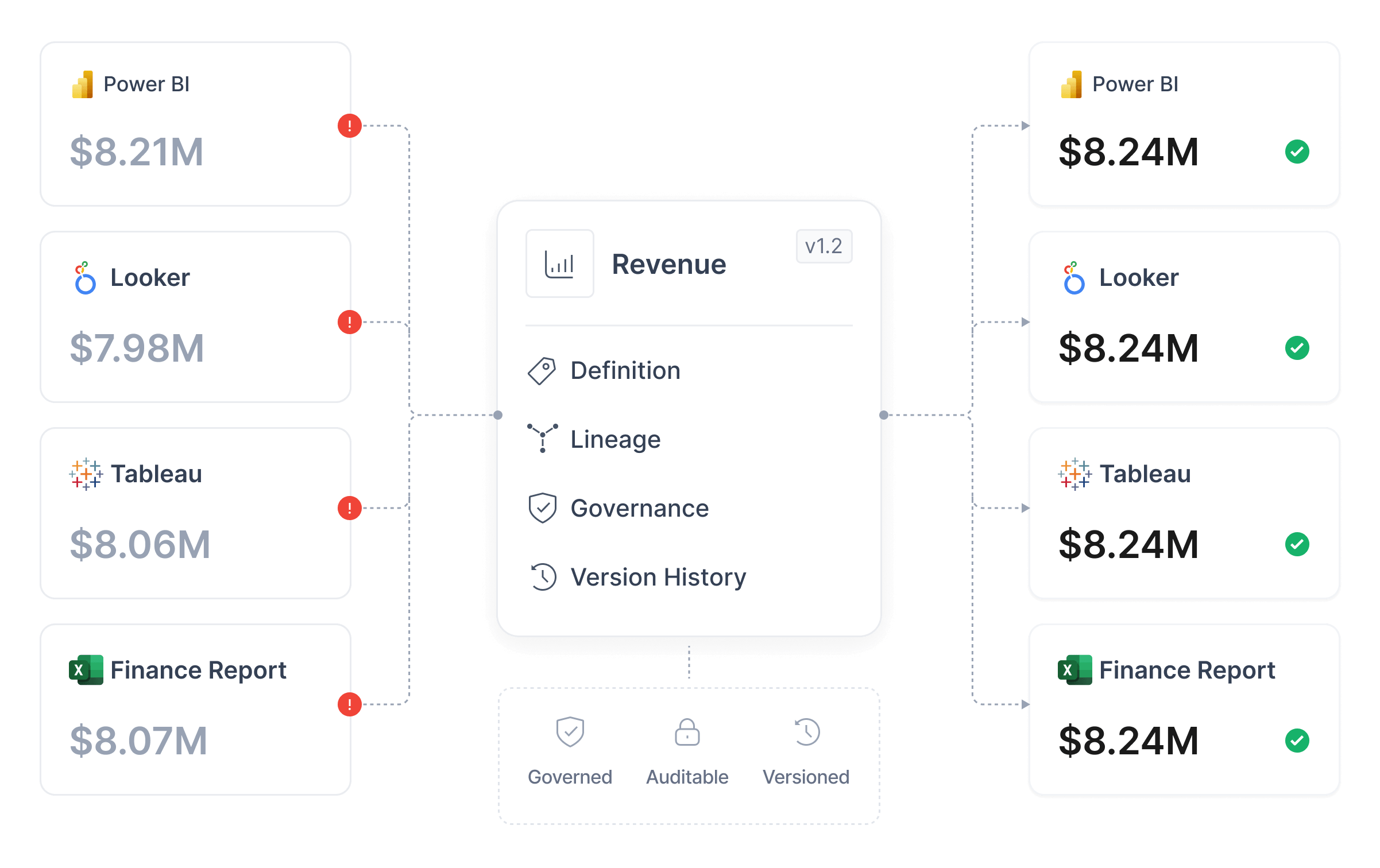
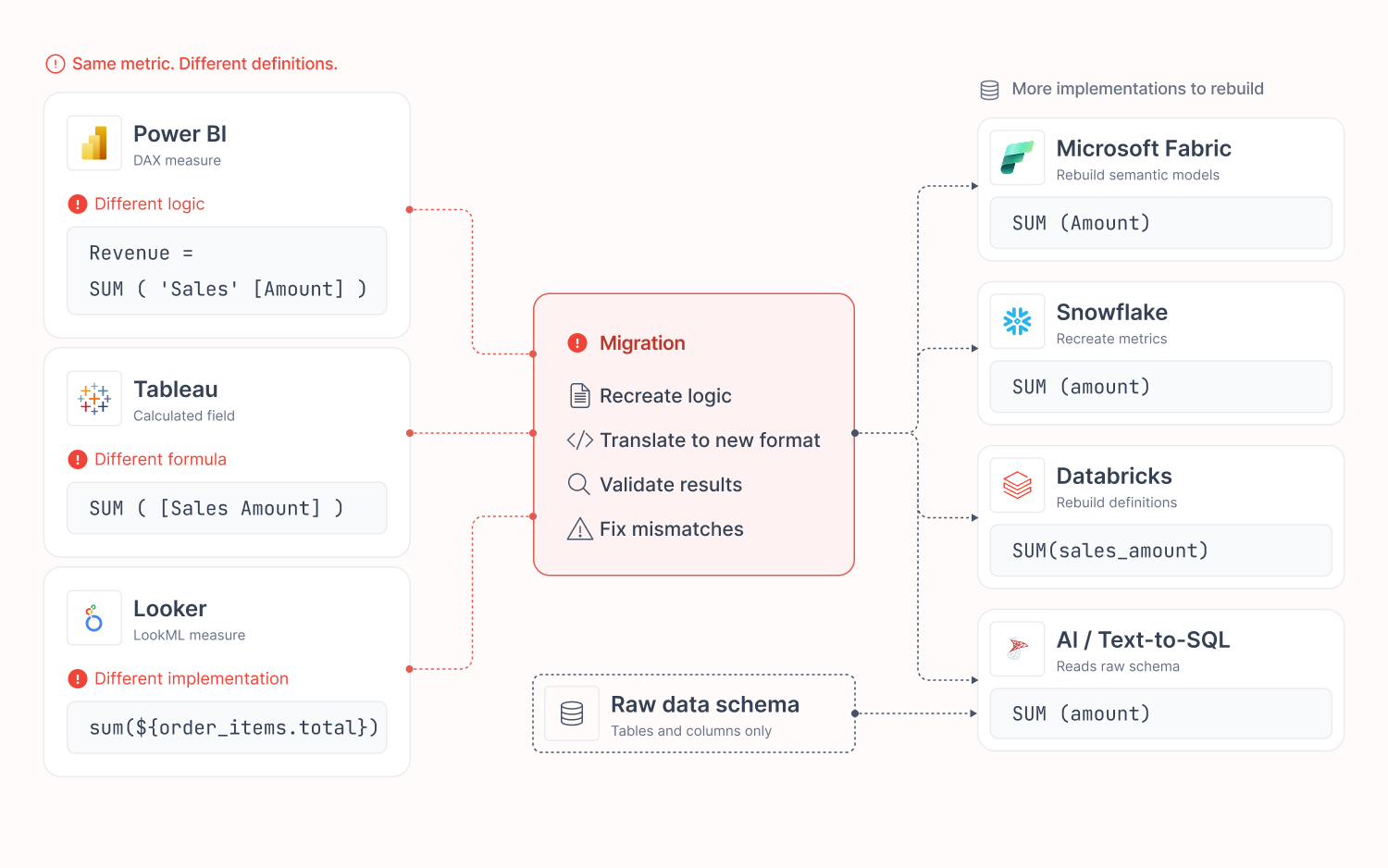
DAX measures in Power BI, calculated fields in Tableau, LookML in Looker. Each tool keeps business logic in its own format, so revenue gets rebuilt in each one, a little differently each time.

Reconciliation takes a fixed share of every sprint, and the executive complaint arrives in the same words each quarter: the numbers don't match.

Then a migration lands. A Tableau to Microsoft Fabric move puts years of semantic models up for a rebuild, and a text-to-SQL pilot reading raw schema produces a third version of revenue.
The Approach

Import what you have, then compile it everywhere

Semantic Hub reverse-engineers semantic models from Power BI and Tableau, from legacy tools including MicroStrategy, SAP BusinessObjects, IBM Cognos, and Oracle OBIEE, and from Snowflake, Databricks, Oracle, and SAP HANA. Your existing models become the governed baseline.

Reconciliation lines up every version of a metric, shows where they diverge, and lets you merge them into one governed definition. Model testing runs it against live data before it ships, and SHL keeps it in branches, pull requests, and CI/CD like any other code.

Write once, compile anywhere. One definition compiles into Power BI semantic models, Tableau logical models, LookML, Snowflake Semantic Views, Databricks Metric Views, and Oracle Analytic Views, with lineage back to the source column.

What Changes

Migrations that start from your models

Reverse-engineering turns the old platform's models into the governed starting point for the new one.

Sprints spent building

Reconciliation drops out of the sprint because the definitions stop diverging between tools.

Agents that match the dashboard

Snowflake Cortex Analyst and Databricks Genie read the compiled artifacts natively, so AI answers use the same revenue as BI.

Use cases for analytics engineering leads

Why don't the numbers match?

Define each metric once and compile it natively into every BI tool. Power BI and Tableau return the same revenue number because both read the same governed definition. There's nothing left to reconcile.

Can we migrate without rebuilding everything?

Reverse-engineer semantic models from legacy and modern BI, import them as governed starting points, and compile into your target platforms. Years of semantic investment become the foundation of the new stack.

What context did the AI agent use?

Deliver curated definitions, relationships, policies, and provenance to agents via MCP. Every response returns the metadata evidence that produced it, so the answer and its grounding arrive together.

Frequently asked
questions

Which tools can we import semantic models from today?

Power BI and Tableau, legacy tools including MicroStrategy, SAP BusinessObjects, IBM Cognos, and Oracle OBIEE, and the semantic models in Oracle, Snowflake, Databricks, and SAP HANA. Import and export for Microsoft DAX, Apache Ossie, and other semantic modeling tools is planned.

We're in the middle of a migration. Is this the wrong time?

The migration is the reason to start. Reverse-engineer the models you have, reconcile the duplicate definitions once, and compile them to the target so the metrics survive the move.

Where do the compiled definitions run?

Inside your warehouse and BI tools, as native artifacts. Semantic Hub compiles each definition before any query runs, so query traffic never routes through a MetaKarta engine.

What happens when a definition changes?

The change goes through the same branch, review, and CI/CD path as your code. Once approved, Semantic Hub recompiles it into every target that reports the metric, and the change is versioned and attributed.

Do access rules carry over to each tool?

Security policies are defined once and compile into native controls in each target, so every tool enforces the same rules.

What do we keep if we stop using MetaKarta?

Remove us tomorrow. Your definitions stay. The compiled artifacts are native objects in your tools, and the source definitions are SHL files your team can read and version in Git.