Industry Validation
Gartner Magic Quadrant returns
"D&A leaders must improve metadata management maturity or risk AI failure."

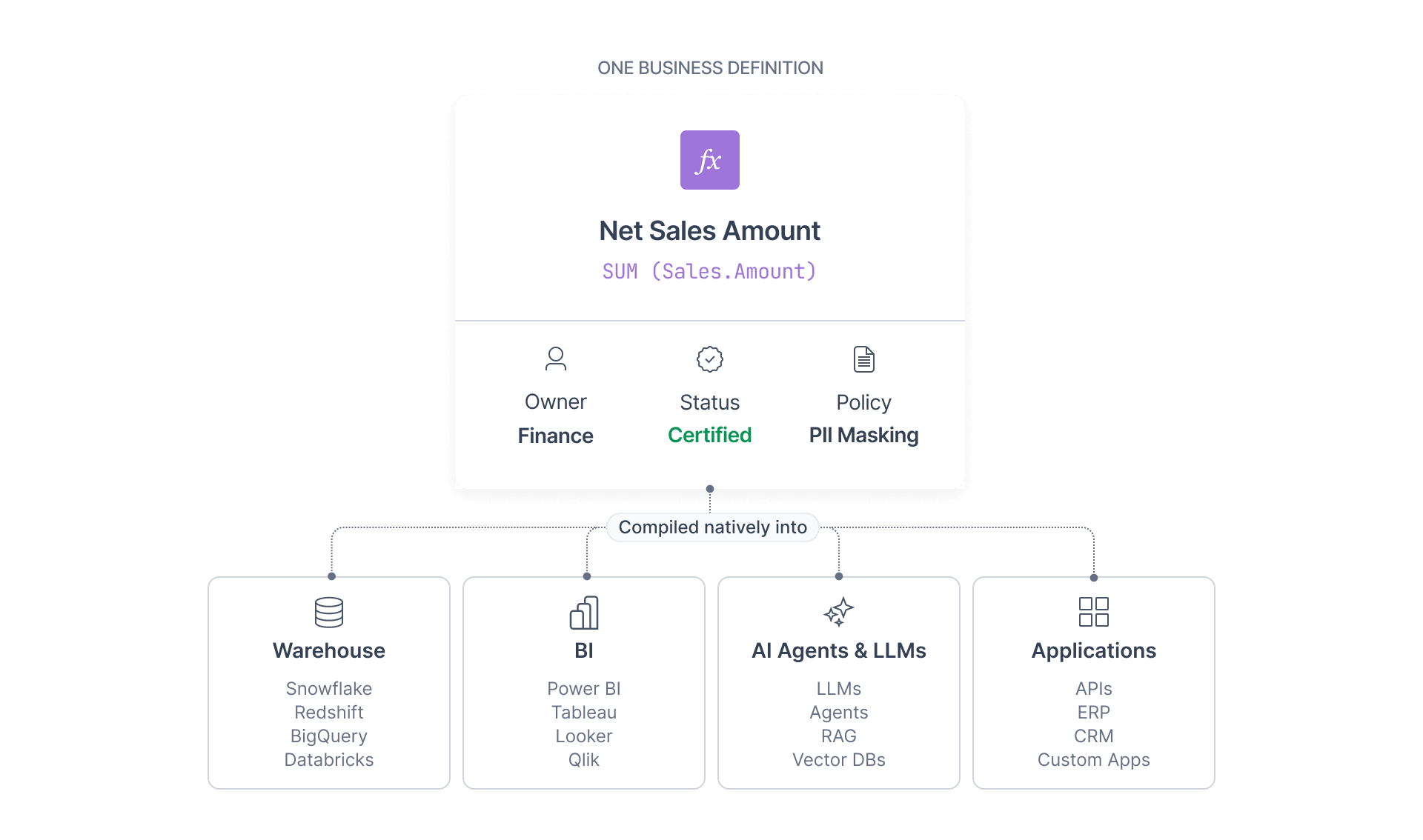
MetaKarta compiles governed business logic natively into data warehouses, BI tools, and pipelines, while serving the same to AI agents as compiled context. Now you can trust that what governance says is what systems actually do.

For two decades, metadata management meant writing things down in glossaries, catalogs, policies, and stewardship workflows. They were built to observe, document, and surface. That was enough when the consequences of inconsistency were survivable.

Humans can catch BI discrepancies before they ship. Agents inherit fragmented business context without flagging it, passing the inconsistency straight through. The failure surfaces after damage has been done.

GDPR, SOX, BCBS 239, and AI governance frameworks don't accept documented intent as proof of compliance. Policies that document intent without showing enforcement are a liability.
Gartner Magic Quadrant returns
"D&A leaders must improve metadata management maturity or risk AI failure."
Native connectors
OEM metadata expertise
Enterprises need a single enforced definition of what their data means, across the full stack, so that reporting is trusted, AI is reliable, and governance is defensible.
Meta Integration Technology’s nearly thirty years of OEM metadata expertise, embedded inside Microsoft Purview, Informatica from Salesforce, Oracle, IBM, and Qlik Talend, provide the engineering depth and breadth needed for MetaKarta to meet the complexity of diverse enterprise data estates, now and in the future.
Spanning legacy to modern and on-premises to cloud, no source in your estate sits outside of MetaKarta. Plus, no run-time middleware and no proprietary engine means there’s no vendor lock-in.
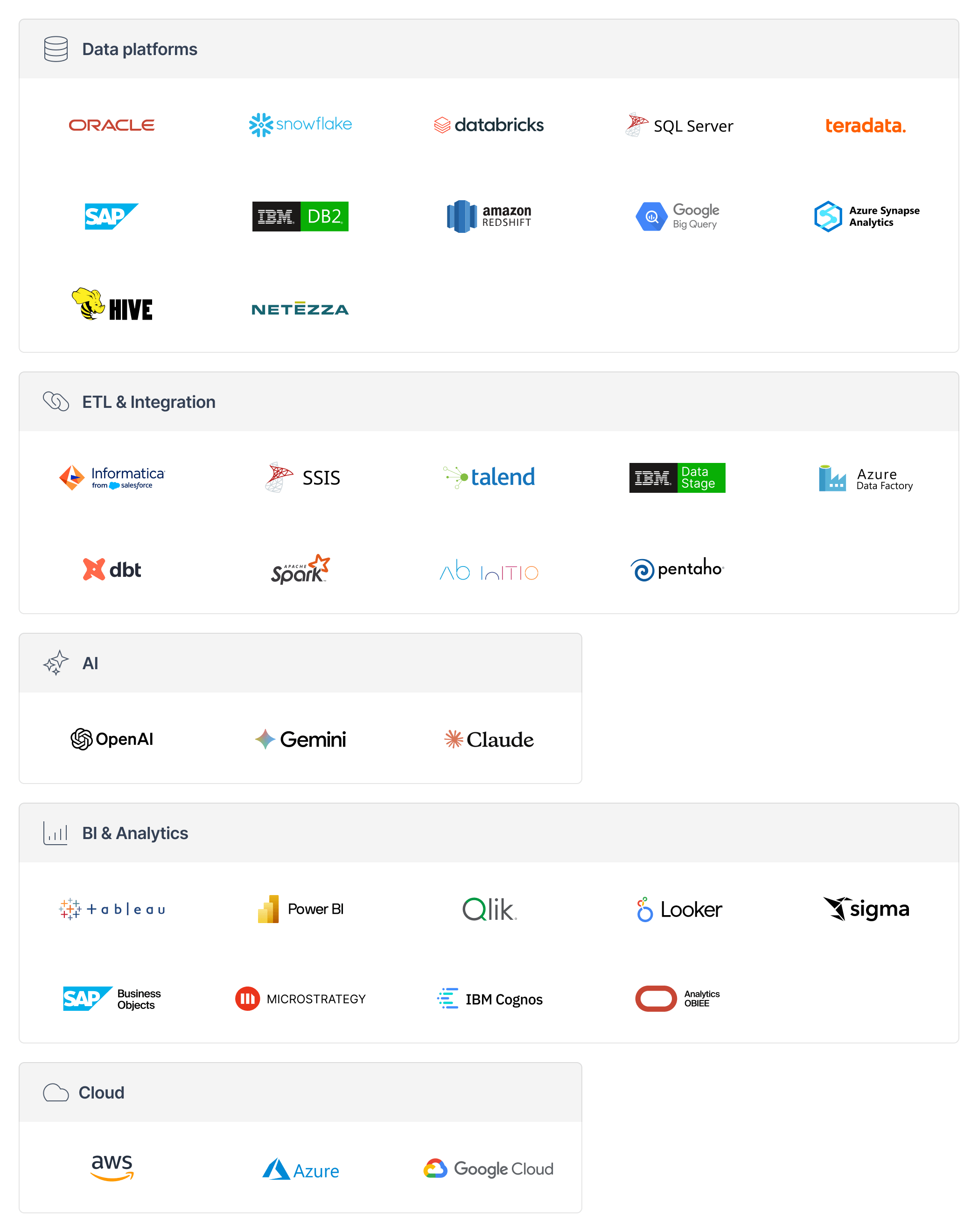
MetaKarta fits into your existing ecosystem without replacing the tools your teams already rely on.


MetaKarta fits into your existing ecosystem without replacing the tools your teams already rely on.








Whether you choose hosted or self-hosted, it’s the same platform. You get feature parity anywhere you deploy it without sacrificing functionality.

Fully managed by MetaKarta

Deploy in your own cloud environment

Deploy entirely on your own infrastructure
Fragmentation compounds with every tool you add. Definitions established in a catalog stop at the catalog. Logic defined in a runtime semantic layer governs a single consumer. Lineage tracked in one tool stays in that tool, disconnected from the governance workflow that depends on it.
One view of authority, and manual coordination between the rest
Each specialized tool holds a partial view of your data estate, with no shared repository connecting it to the others. The result is a governance program assembled from tools that share no common foundation, where enforcement runs on manual coordination and consistency depends on people keeping up.
Drawbacks

Catalog tools document definitions but have no authority over the warehouse or pipelines that implement them
Runtime semantic layers standardize metrics for one consumer but sit in the query path, adding latency, and have no lineage into the systems that produce the data
Log-based lineage tools show what ran but miss what was designed to run
Warehouse-native governance covers cloud assets but legacy systems and on-premises infrastructure remain outside it
Integrated architecture on one shared foundation across all four capabilities
MetaKarta operates lineage, cataloging, governance, and semantic enforcement against a single shared metadata repository. Every governance decision is grounded in the same lineage. Every enforced definition reaches the systems that consume it natively, with no manual coordination in between.
Advantages

Governed definitions compiled into your warehouse, BI tools, and pipelines not documented for someone to act on later
400+ connectors cover your full estate: legacy and modern, on-premises and cloud
Lineage by design, not by observation. Computed from actual code artifacts, not inferred from runtime logs
AI agents reason against governed, canonical definitions, not raw, ungoverned data
MetaKarta establishes the shared metadata foundation organizations have been trying to patch together for years: trusted BI, reliable AI, and defensible governance, compiled into every architecture, every cloud, and every tool. No runtime dependency. No vendor lock-in. No greenfield start required.


Most metadata stacks are assembled from separate lineage, catalog, governance, and semantic tools that each hold a partial view of the estate and need constant synchronization. MetaKarta runs all 4 capabilities on one shared metadata repository and compiles governed definitions into downstream systems natively and delivers compiled context to AI agents. Consistency is a property of the architecture, and enforcement happens at build time.
Compile-time enforcement means governed definitions are written into the native format of each downstream system, such as Snowflake Semantic Views, Databricks Metric Views, Power BI semantic models, and Tableau data sources, before any query runs. Definitions arrive baked into the tool itself, so nothing has to intercept queries at runtime to apply them.
Parser-based lineage is computed from the actual code that moves data: SQL, ETL jobs, and BI semantic models. It's column-level, cross-system, and complete by construction, including designed paths that haven't been executed recently. Log-based lineage infers flows from runtime observation, so it captures what happened to run during the observation window. Lineage by design, not by observation.
A run-time semantic layer standardizes metrics by sitting in the query path between BI tools and the warehouse, which adds latency and creates a run-time dependency. MetaKarta compiles governed definitions directly into each platform's native format, so queries run exactly as they do today. The compiled artifacts are customer-owned and keep working independently of MetaKarta.
No. We don't sit in your query path. We've already compiled into your database and tools. Queries execute natively in each platform, with no middleware in between and nothing that has to stay available at runtime.
Vendor neutrality is structural: MetaKarta connects to 400+ platforms spanning legacy and modern, on-premises and cloud, and compiles into each one's native format without a proprietary runtime. Meta Integration Technology has supplied OEM metadata technology to competing platform vendors for nearly 30 years, which is why it's been called the Switzerland of Metadata.