Mike Hetrick
Director, Product Marketing
Connect with us

Semantic layers promised one source of truth, but today’s enterprise stack has multiplied them across BI tools, warehouses, and AI systems. MetaKarta’s compile-time approach establishes one governed source and deploys its definitions as native artifacts across every target platform.
The semantic layer was supposed to solve the metric consistency problem.
One place to define revenue. One place to define margin. One source of truth for every calculation your business runs on. Write it once, and every BI tool, every AI query, every embedded report pulls from the same governed definition.
That was the pitch.
Tableau has semantic models. Power BI has TMDL. Looker has LookML. Snowflake shipped Semantic Views. Databricks has Metric Views. Cube, AtScale, and dbt each claim to be the one layer that unifies the others.
After 2025, the average enterprise data stack doesn't have a semantic layer. It has 6.
One for the warehouse. One for the BI platform. One the data team built in dbt two years ago. One the AI team wired up last quarter so the LLM had something to query. One the platform vendor bundled into your contract renewal. And one that lives in a spreadsheet someone named Kathy owns and nobody else touches.
Vendors added semantic capabilities because it was easier to sell complete platforms than interoperable ones. The proliferation followed.
The result: the problem the semantic layer was supposed to solve is now the problem the semantic layer created.
When there's one source of truth, governance works. You audit the one source. You version the one source. You resolve conflicts against the one source.
When there are 6, you have a different question: which one is authoritative?
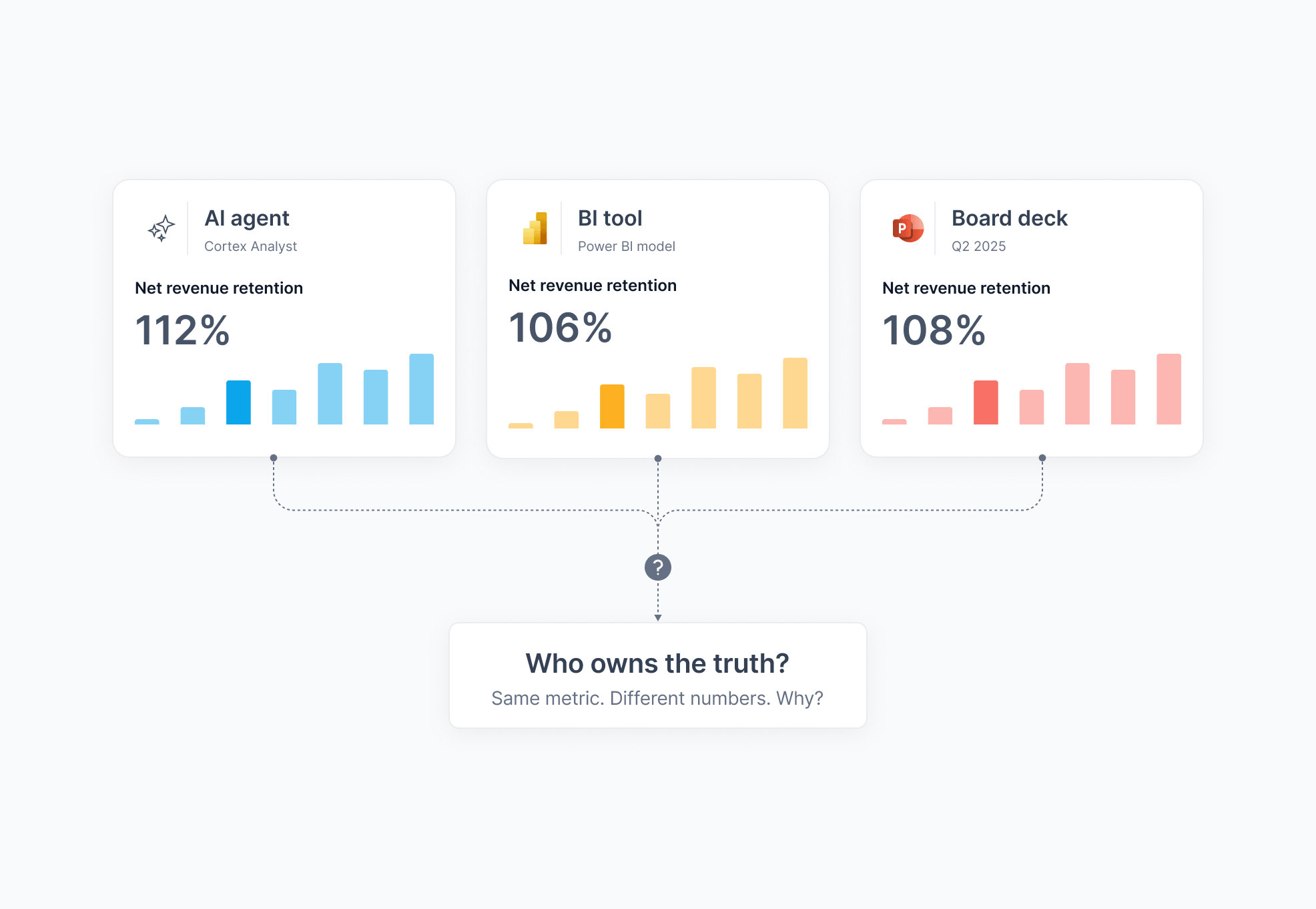
The BI tool says revenue is net of returns. The AI agent queries the warehouse semantic model that hasn't been updated since Q3. The executive dashboard pulls from Looker still running the old attribution logic. The Cube layer the data engineering team stood up has the right definition, but it only connects to 3 of your 12 data products.
Every layer was authoritative when it was built. None of them know the others exist today.
This is metric sprawl at the infrastructure level. An architectural problem, not a governance policy one.
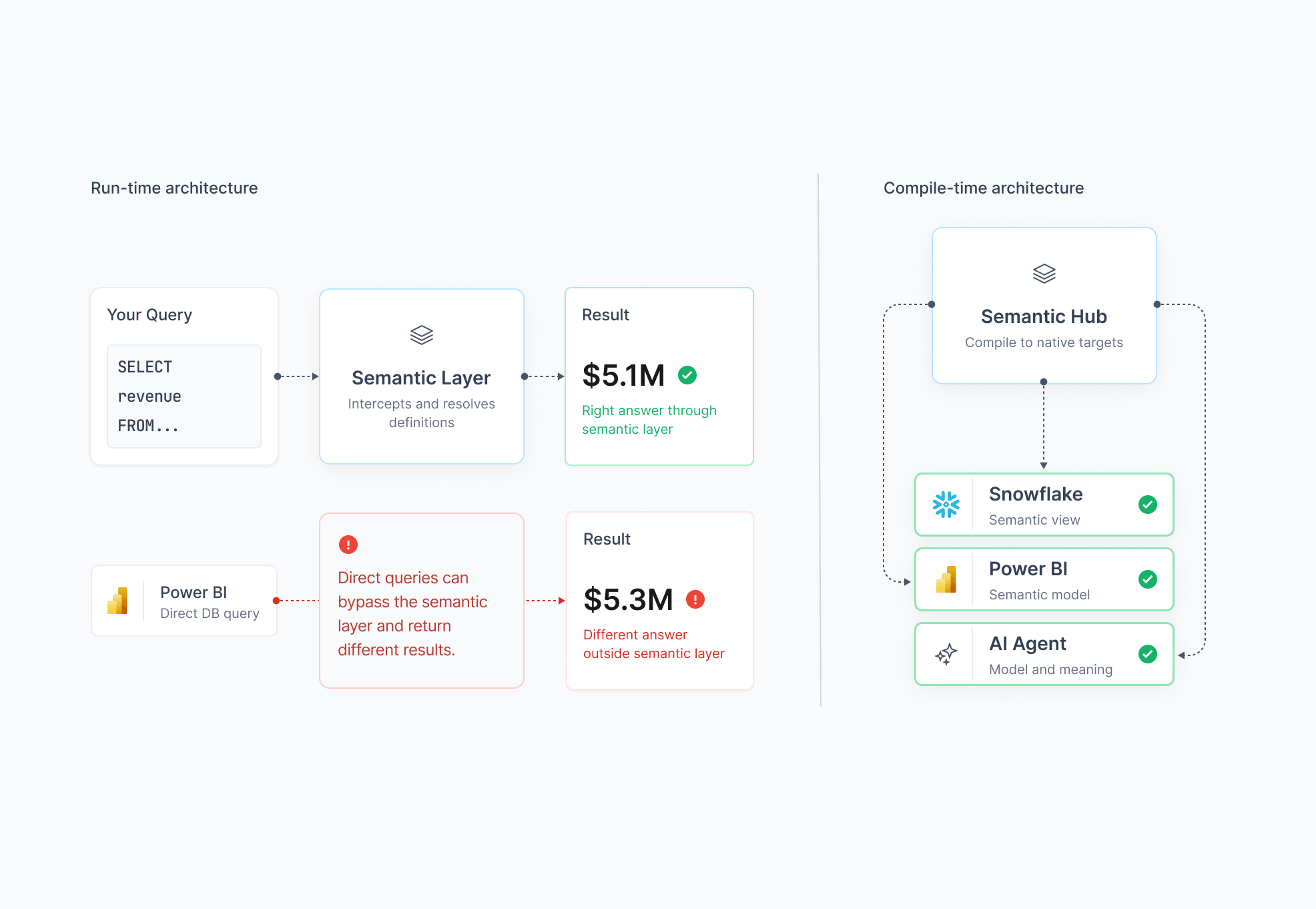
A layer sits between things. Run-time middleware in the query path: your BI tool asks a question, the layer intercepts it, enforces a definition, returns a result.
That architecture works cleanly when there's one layer and one query path. It fractures when there are multiple layers, multiple paths, and no mechanism to reconcile them.
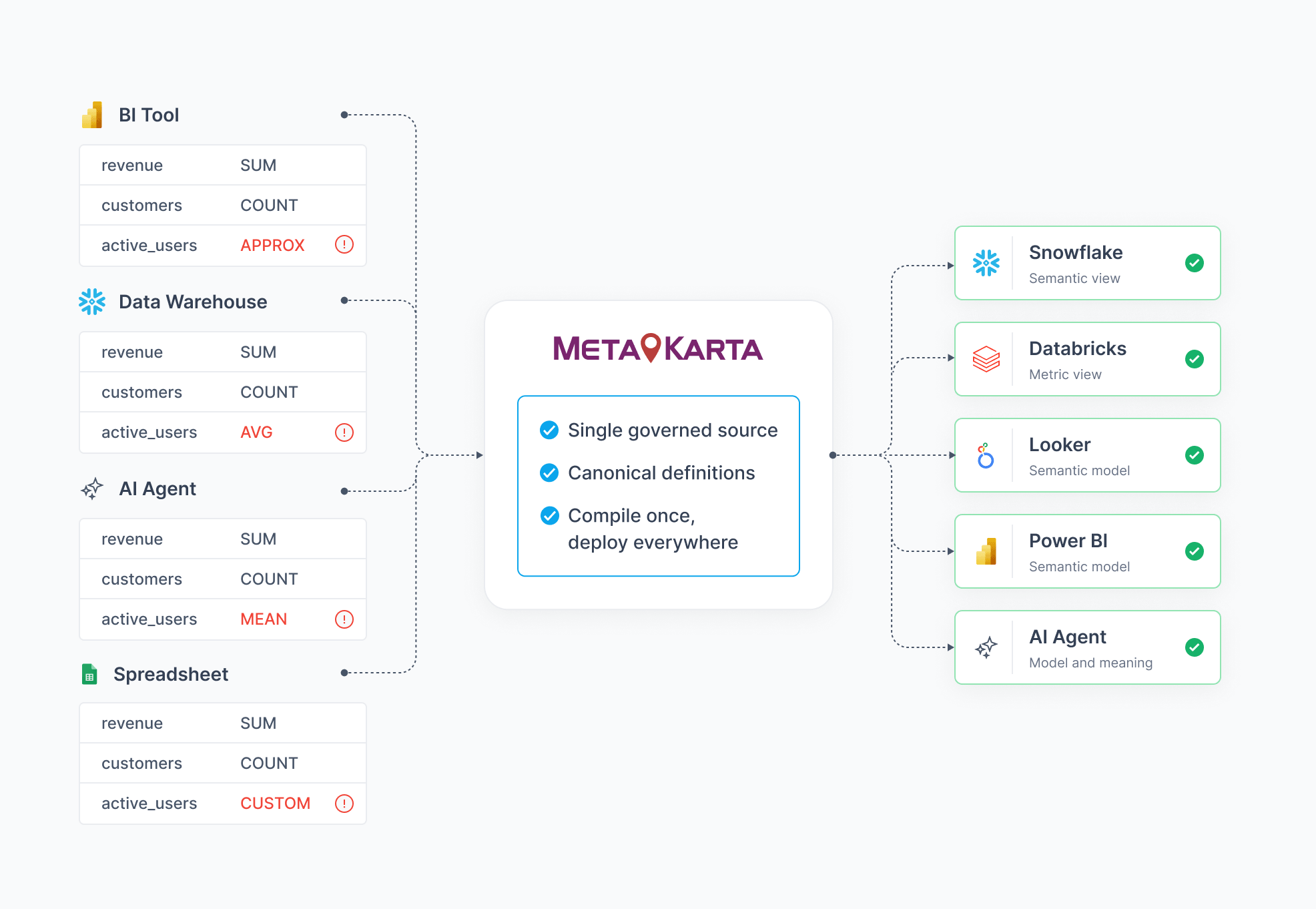
The layer metaphor also implies passivity. It sits. It waits. It responds when queried. But the definition problem isn't a query-time problem. The damage happens long before the query runs. It happens when 5 different teams defined "active customer" 5 different ways in 5 different tools, and nobody tracks which definition lives where, who owns it, or whether any of them agree.
Intercepting queries doesn't fix that. Auditing it doesn't fix it. Documenting it doesn't fix it.
Compiling it does.
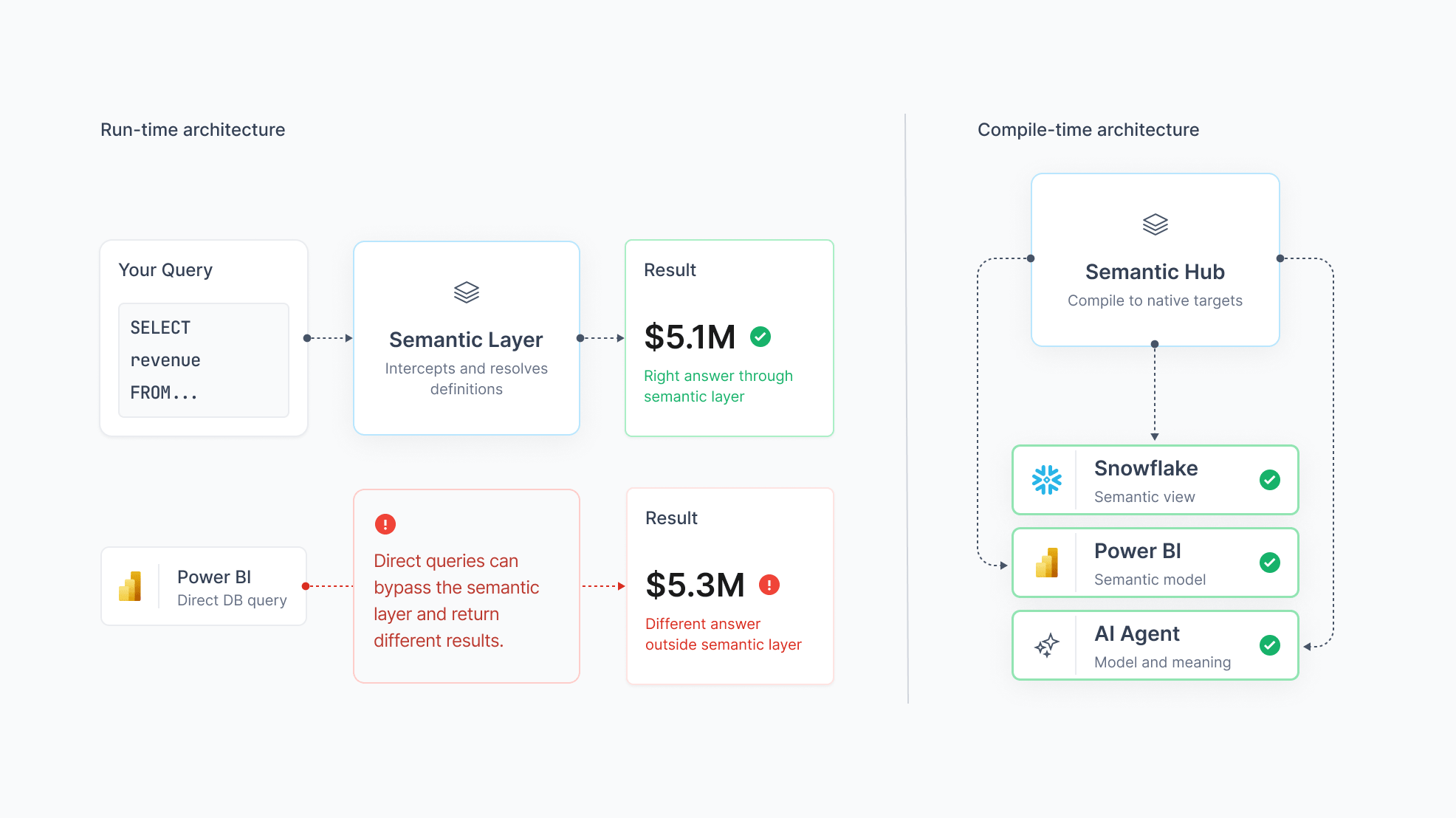
MetaKarta’s Semantic Hub compiles and deploys models and meaning before the query exists.
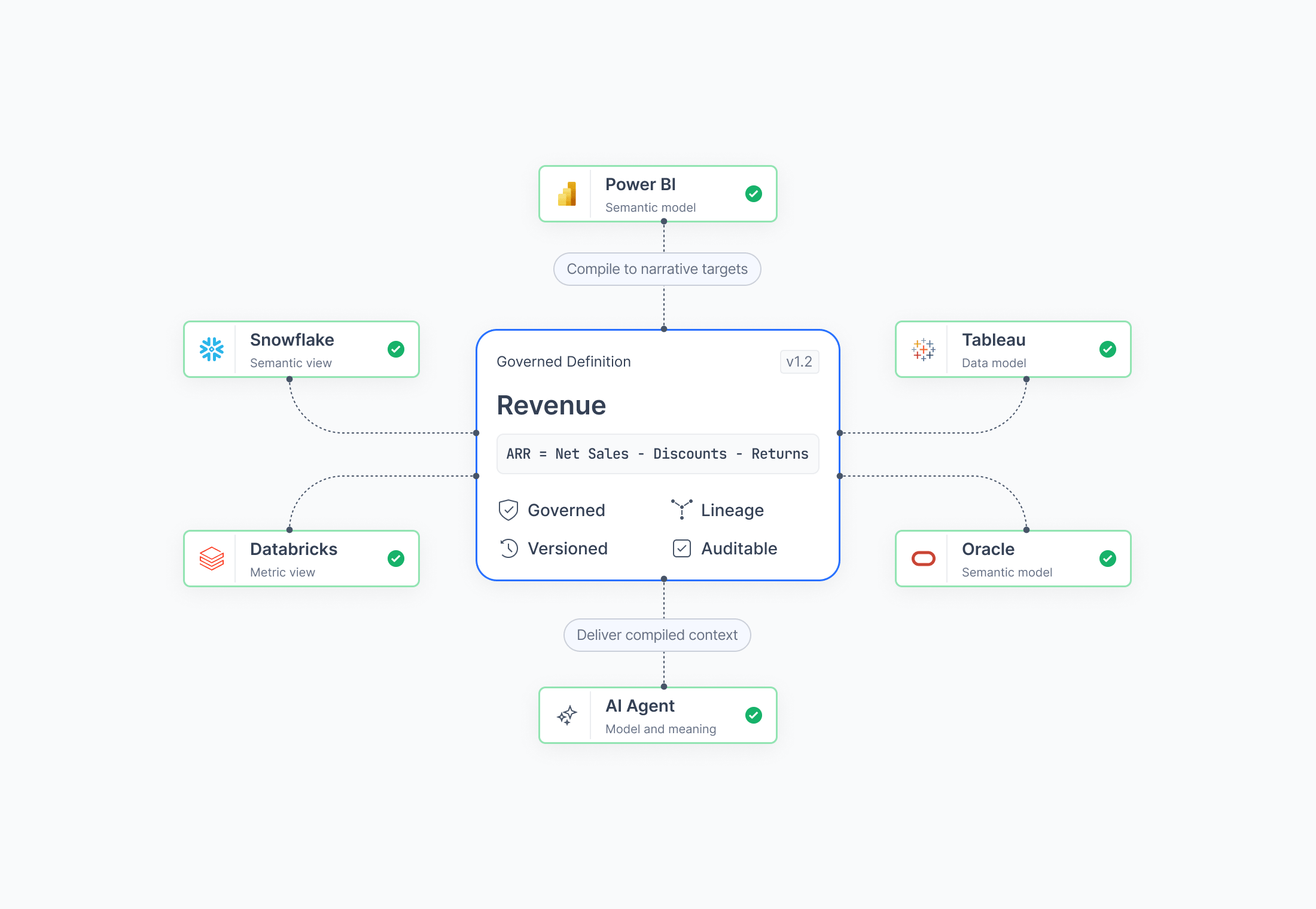
Define a metric once, in the IDE, with version history, ownership, and lineage attached. Then compile it. Semantic Hub writes native artifacts into every target platform that needs it. LookML for Looker. TMDL for Power BI. A Snowflake Semantic View for the warehouse. A Tableau published data source for the BI team.
Each platform gets its own native artifact. The definition embeds directly into the tool. No middleware intercepting queries, no new latency, no proprietary runtime that becomes a single point of failure.
This is the architectural distinction: Semantic Hub writes governed meaning into your infrastructure, not on top of it.
Import existing semantic assets from across your stack, consolidate and govern the definitions in a single environment, then compile them into whatever targets you need. Write once, compile anywhere.
Authority resolves because there's only one governed source feeding all the tools, not multiple layers competing to be authoritative.
If your org has invested in a semantic layer, at the time, for the scope, it was probably the right call.
The real question is whether that layer is still the authority as your stack grew. How many tools now have native semantic capabilities that contradict it? How many definitions exist outside it? When an auditor asks where a number came from, how many hops does it take to trace it back to a governed definition?
If those answers are uncomfortable, the layer was never the right abstraction for an enterprise-scale estate.
The compile-time approach is. Get in touch to learn more about how Semantic Hub compiles and deploys native artifacts to establish BI metric consistency.