AI Context & Governance

Agents that answer from definitions you already govern

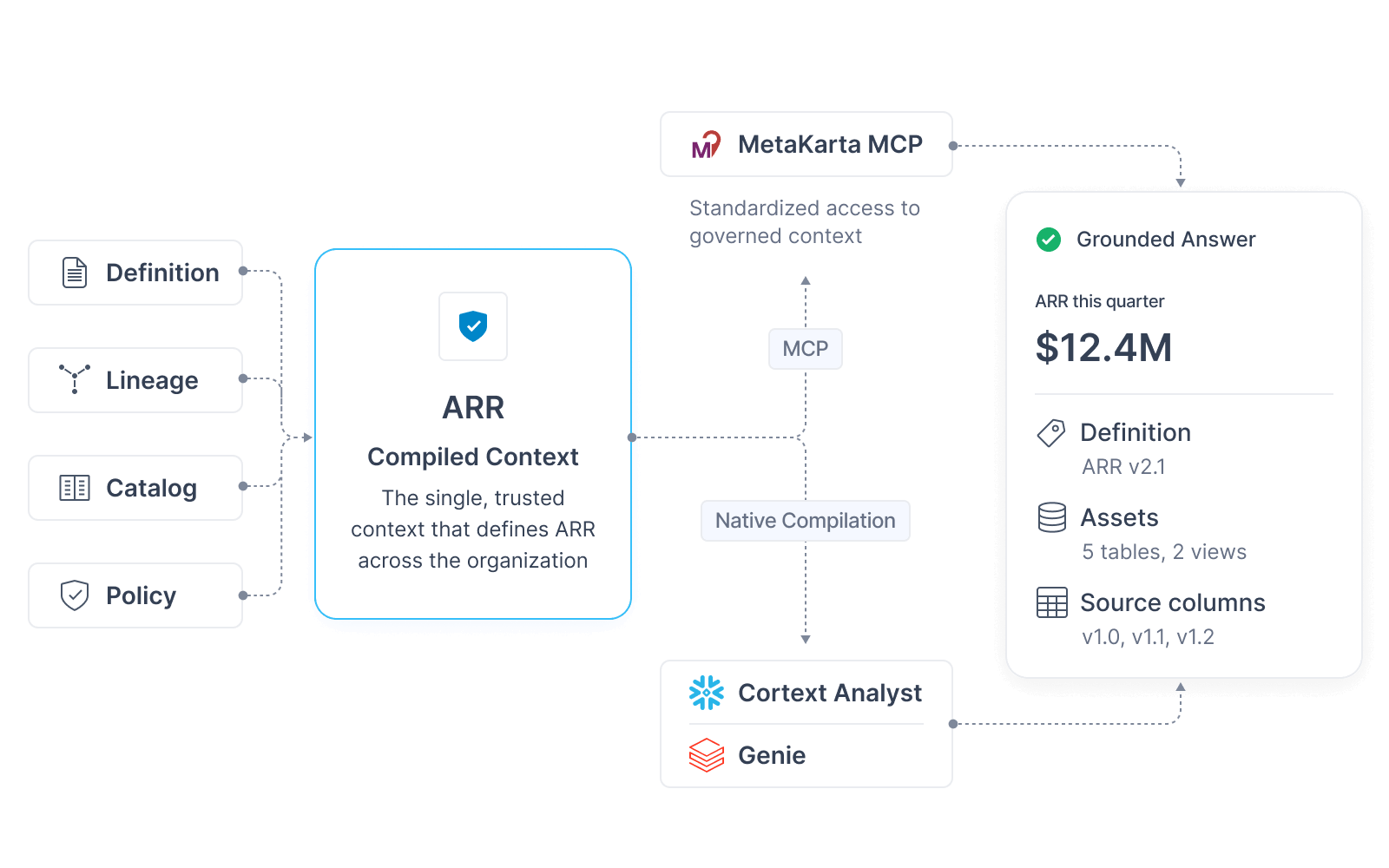
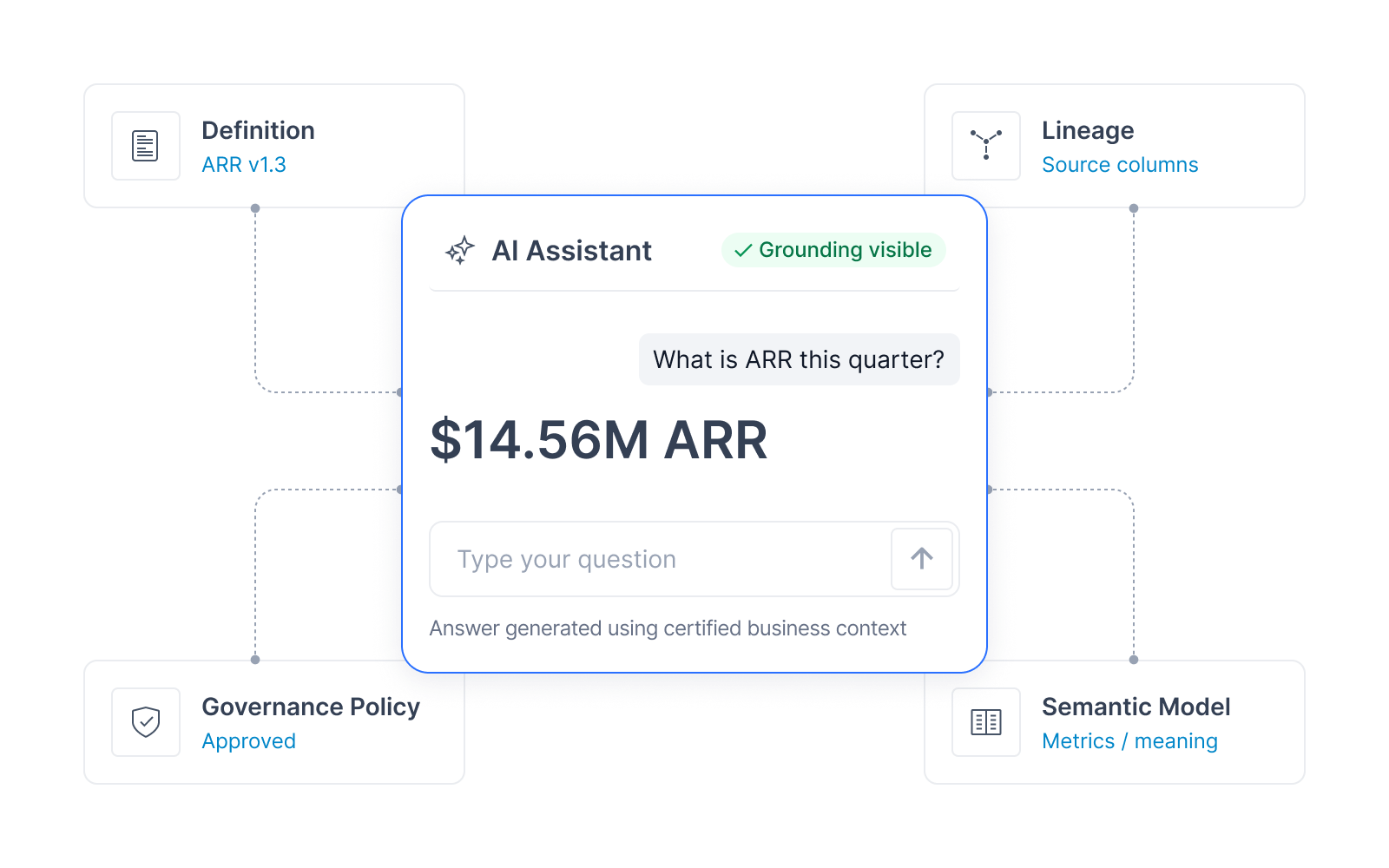
MetaKarta serves compiled context to AI consumers, so a model resolves "ARR" against the definition your stewards approved. Every response comes back with the metadata evidence behind it.

Key capabilities

Compiled context served through MetaKarta MCP

Structured AI consumption in Snowflake Cortex Analyst and Databricks Genie

Column-level lineage from the answer back to the source

Grounding validated in Context Sandbox before production

The Problem

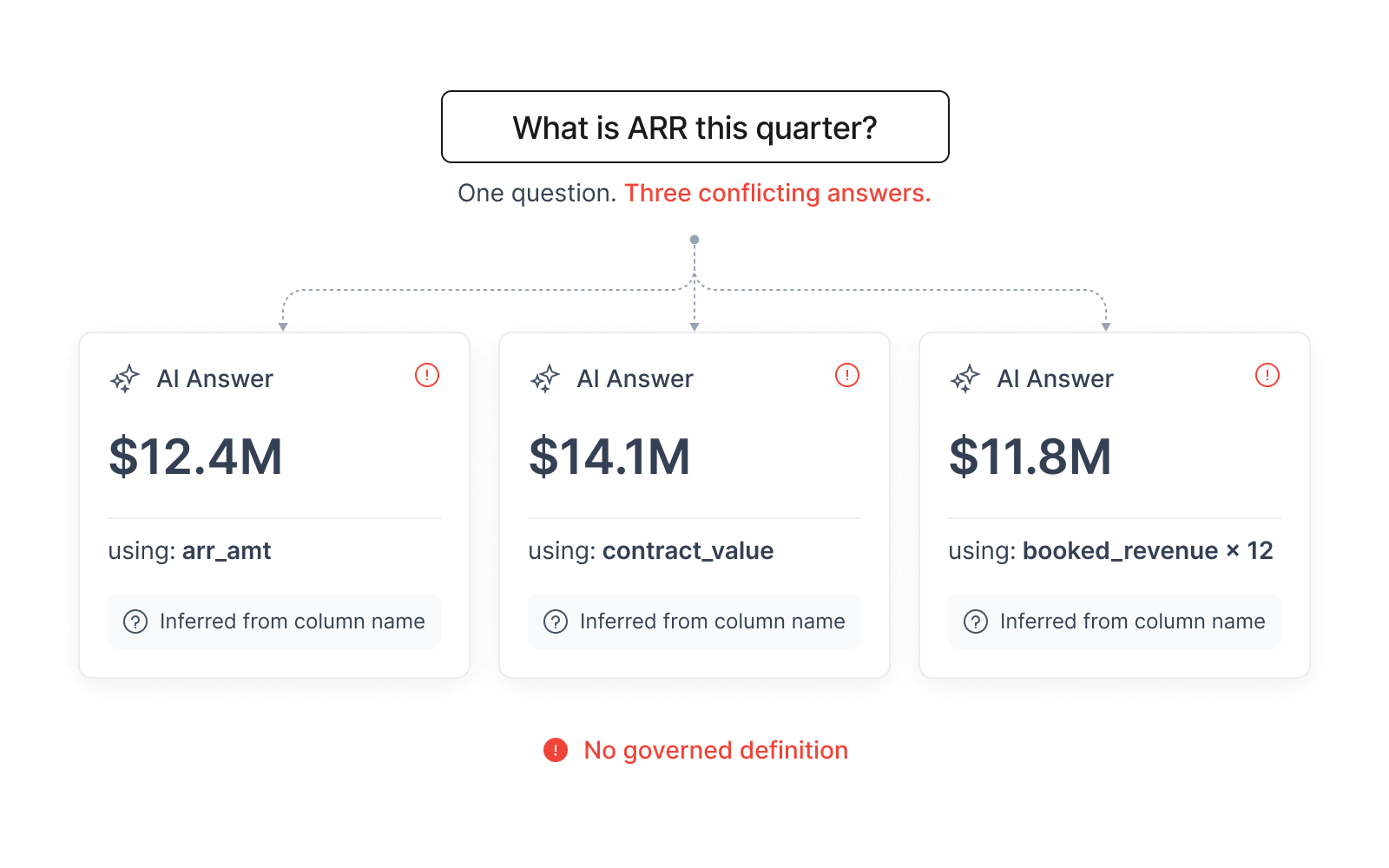
A model asked about revenue will guess, and guess differently each time

AI queries against raw schema produce inconsistent answers. The model infers what "ARR" means from column names and gets it wrong in a new way every time. Text-to-SQL breaks on metric fragmentation.

AI governance mandates are arriving faster than the technical path to meet them. Provenance, auditable outputs, and traceable answers are all being asked for, and a prompt workaround supplies none of them.
The Approach

Serve the agent the same governed context, out of the same repository

Canonical metric definitions, column-level lineage, catalog entries, and governance policies all sit in one shared metadata repository. MetaKarta MCP exposes them to AI consumers through two toolsets, Metadata Management Tools and Semantic Hub Tools.

Agents also reach governed definitions through structured AI consumption in Snowflake Cortex Analyst and Databricks Genie, because Semantic Hub has already compiled those definitions into the warehouse's native format.

Context Sandbox runs a real business question against the ontology before anything reaches production, showing which definitions the answer used, which relationships it traversed, and which assets it touched.

Test the claim yourself, on your data, with the grounding visible.

What Changes

Answers that hold up twice

Same answer, AI and BI. Proven accuracy. Deterministic.

A provenance chain you can follow

Every answer traces from the response, through the transformation, back to the source column.

Cost you can predict

Compiled context, deterministic SQL. No compute tax, no token tax.

Frequently asked
questions

Why does our AI assistant give a different revenue number than the dashboard?

The assistant works out what "revenue" means from column names and table structures, while the dashboard runs a definition someone coded years ago. Two sources of meaning produce two numbers. When the agent and the dashboard both resolve against the same governed definition, they return the same answer.

How do AI agents reach the governed definitions?

Two paths. External agents connect through MetaKarta MCP, a single server with two toolsets: Metadata Management Tools for lineage, catalog, and governance metadata, and Semantic Hub Tools for compiled context and deterministic SQL. Snowflake Cortex Analyst and Databricks Genie read the governed definitions directly, because Semantic Hub has already compiled them into the warehouse's native formats of Snowflake Semantic Views and Databricks Metric Views.

Which AI tools and models work with it?

Any MCP-compatible agent can connect to MetaKarta MCP, and Cortex Analyst and Genie read the compiled definitions natively. For AI-generated documentation inside MetaKarta, you pick the LLM provider: Anthropic, Google, Ollama, OpenAI, or Azure OpenAI.

Can an agent see data the person using it isn't cleared to see?

Access runs on per-user tokens, so an agent sees exactly what the person behind it is authorized to see. Every response returns the metadata evidence that produced it, permissioned to the requesting user.

How do we check an agent's grounding before it goes live?

Context Sandbox runs a real business question against the ontology and shows which definitions the answer used, which relationships it traversed, and which assets it touched. Ontology Modeling binds business entities, relationships, and hierarchies to the semantic models and physical columns that implement them, so what you test in the sandbox is what the agent reads in production.

What does compiled context change about cost?

An agent working from raw metadata pays twice: compute to traverse a graph and assemble context, then tokens to generate SQL that often needs several attempts. Semantic Hub Tools hand the agent compiled context and deterministic SQL built from definitions your stewards approved, so both of those costs drop out.

Does MetaKarta trace the data a model was trained on?

MetaKarta traces the context an agent used to answer: from the response, through the governed definition, back to the source column.