Events
Oracle AI World 2026 Oct 25-28, 2026
Events
Meet Meta Integration Technology at Oracle AI World 2026. Discover how to bring your existing BI and analytics investments into the AI era, making business logic AI-ready.
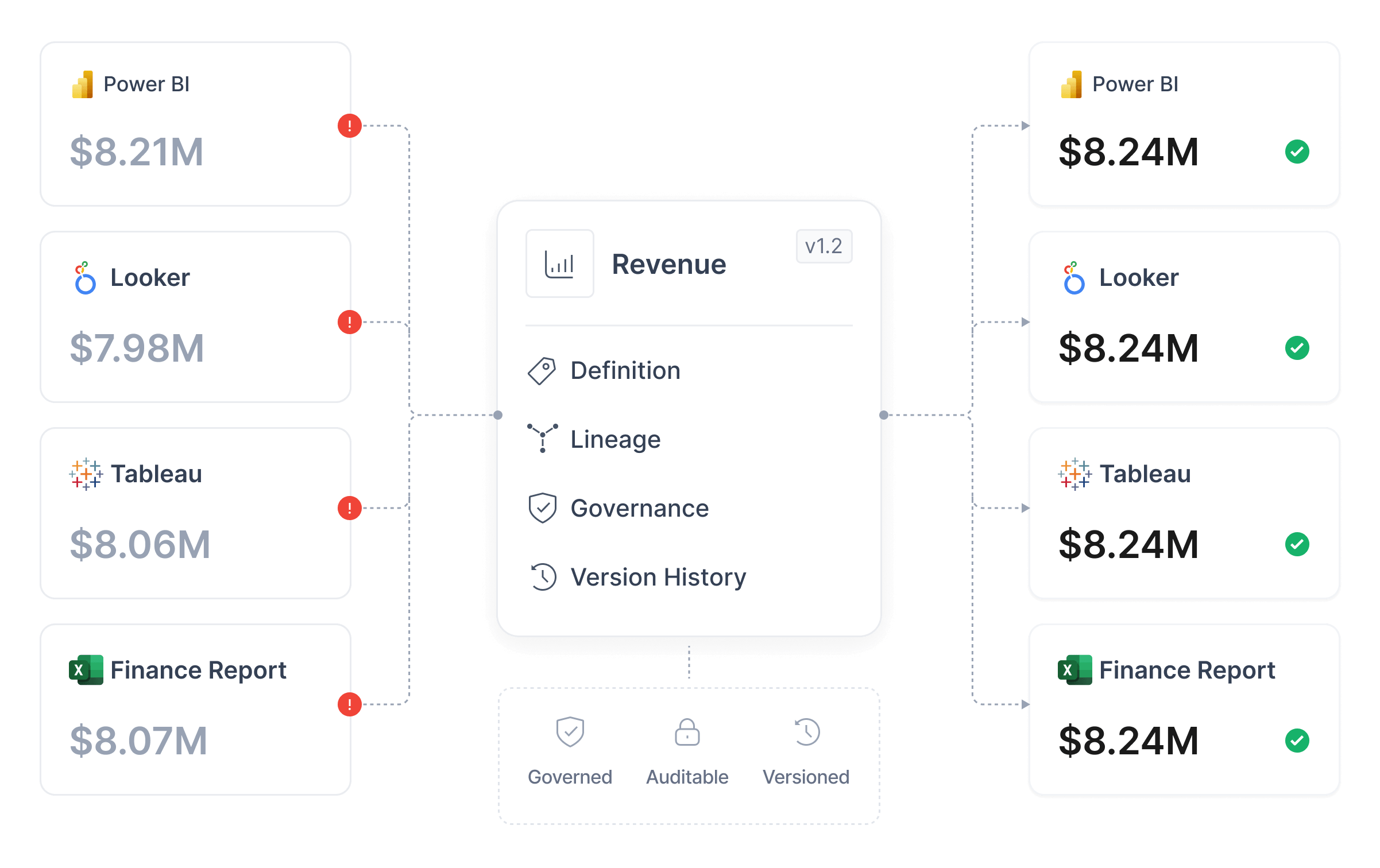
MetaKarta gives data teams one view of the entire data estate, from legacy to modern and on-premises to cloud. Every database, BI tool, and AI agent that reads it shares the same governed definition.

Vendor neutral
|
Compile-time architecture
|
Shared metadata repository
|
Flexible deployment
Inconsistent reporting, unreliable AI, and governance you can't demonstrate share one root cause: business logic fragmented across the stack. MetaKarta fixes the root cause by enforcing shared definitions across the systems you already use.
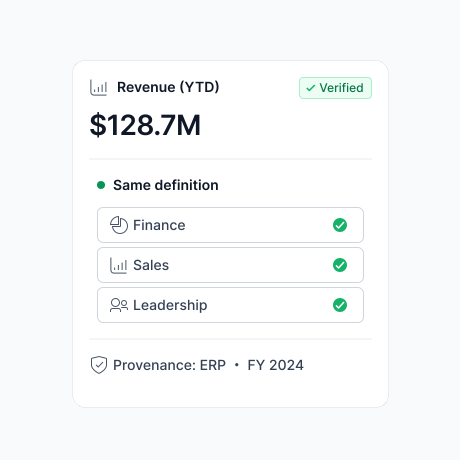
When every team works from the same business definitions, reporting stops depending on who built a dashboard or where data came from. Board reports, operational dashboards, and decisions start from the same trusted foundation.
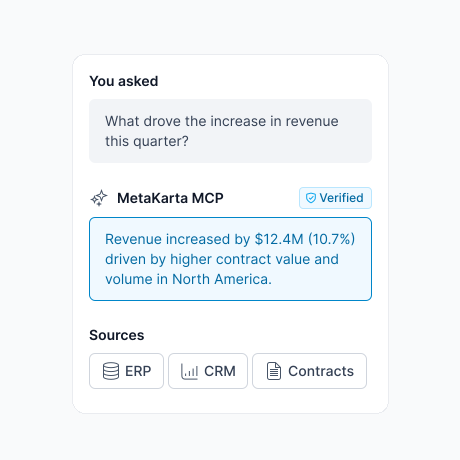
AI becomes more valuable when it understands your business the same way your people do. Instead of interpreting raw schemas or inconsistent definitions, every AI consumer works from governed business meaning.
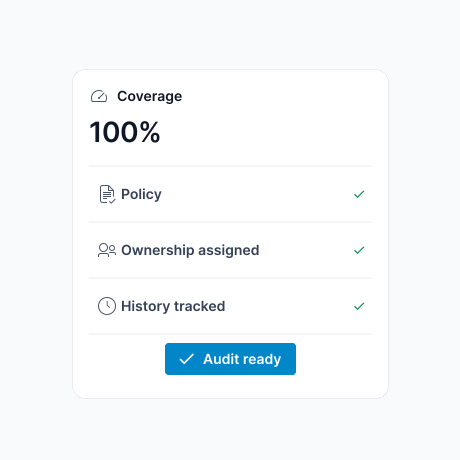
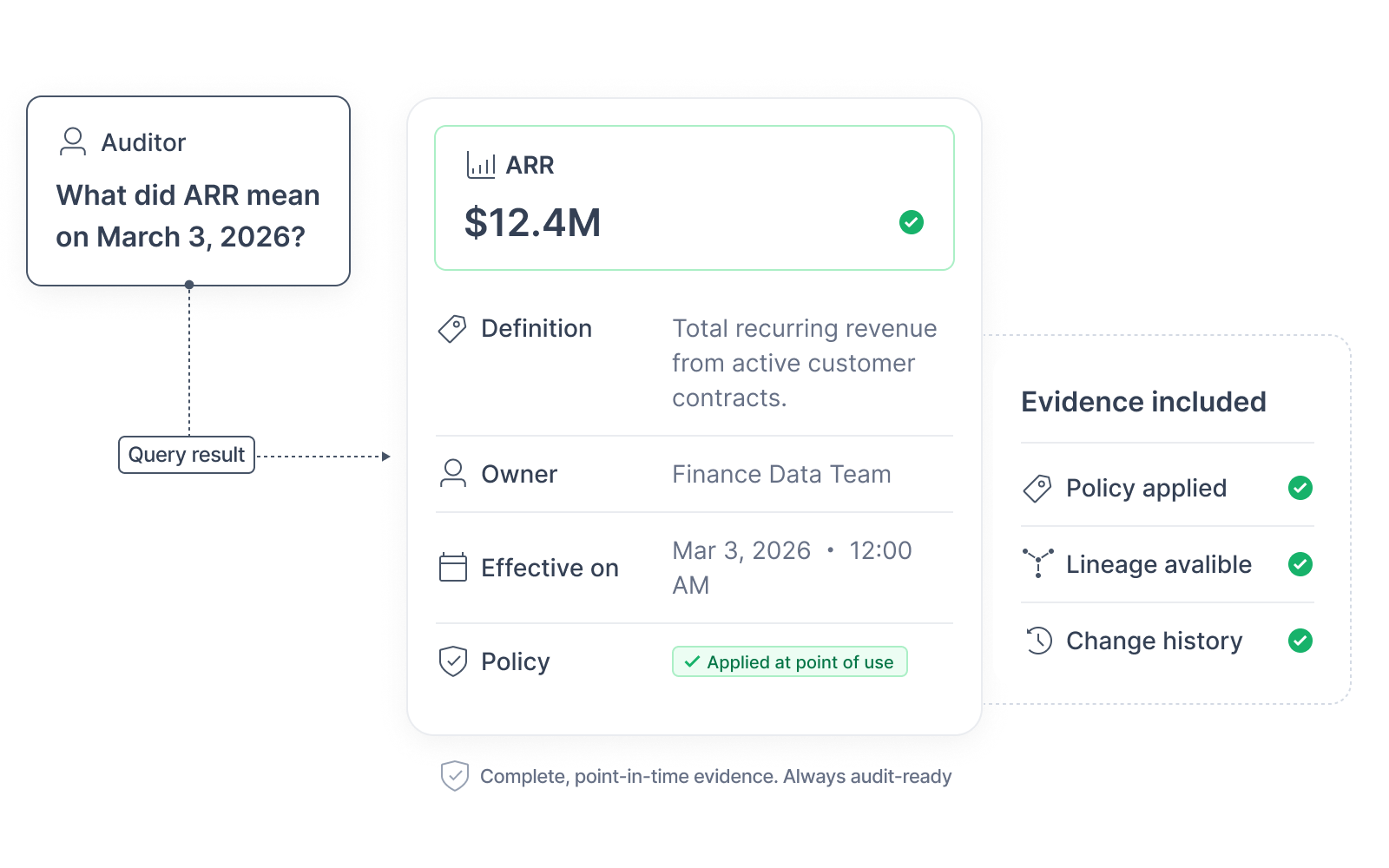
Governance becomes operational instead of procedural. Business definitions, ownership, and history remain connected throughout the organization, making audits, regulatory requests, and internal reviews far easier.
Most enterprises assemble multiple metadata tools bought at different times to solve specific problems. They must be wired together with custom integrations that need constant care. MetaKarta’s platform capabilities aren’t four separate tools you need to integrate, maintain, and synchronize after the fact. They read from and write to a unified metamodel to reduce maintenance overhead.
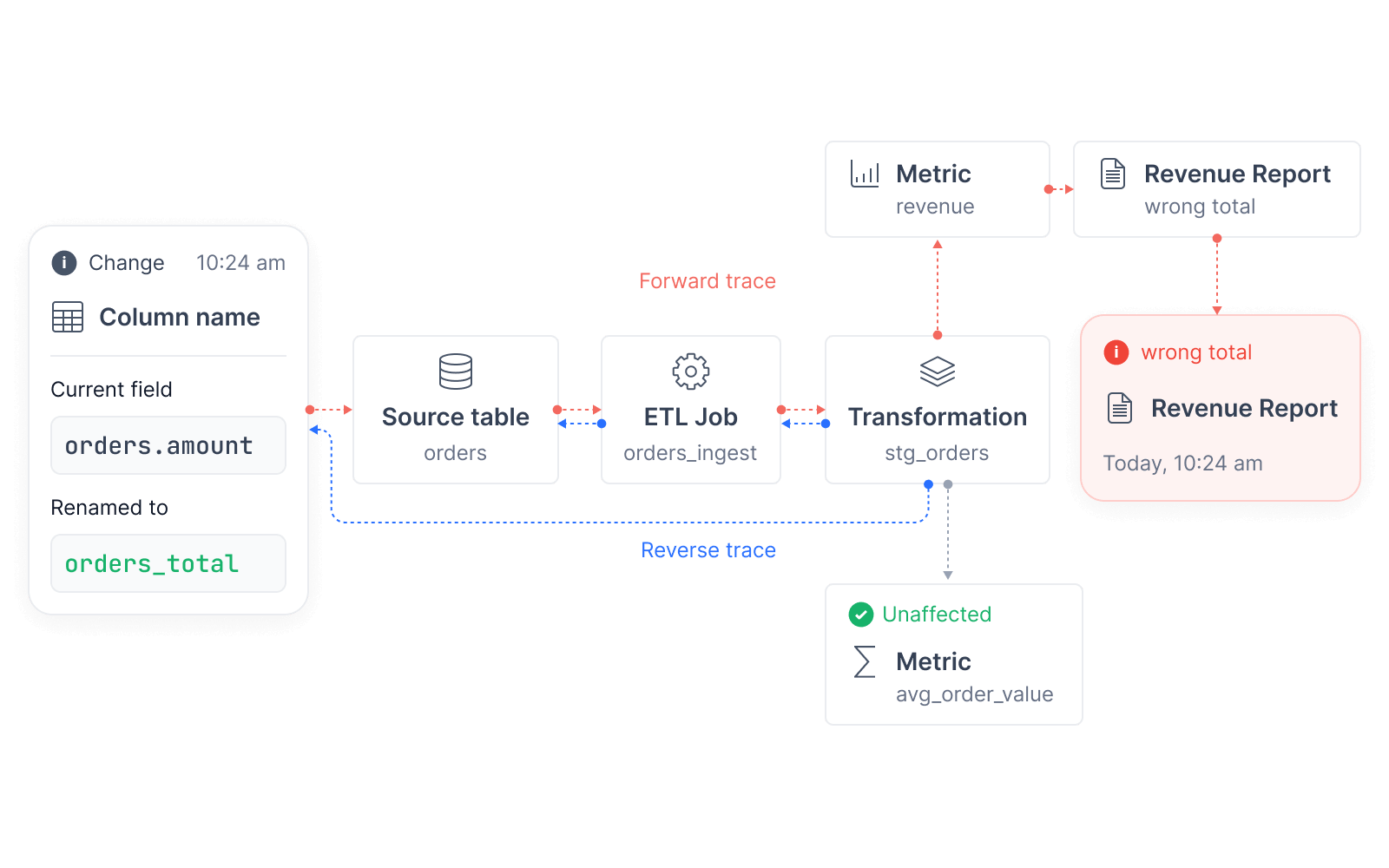
MetaKarta computes end-to-end data lineage by parsing the actual code that moves your data: SQL, ETL jobs, BI semantic models, pipeline definitions, and even COBOL copybooks. Coverage is column-level and cross-system, from source through every transformation to the report or AI output it feeds. Because lineage comes from parsed code, it captures what was designed to run, including the paths run-time logs never see. Lineage by design, not by observation.
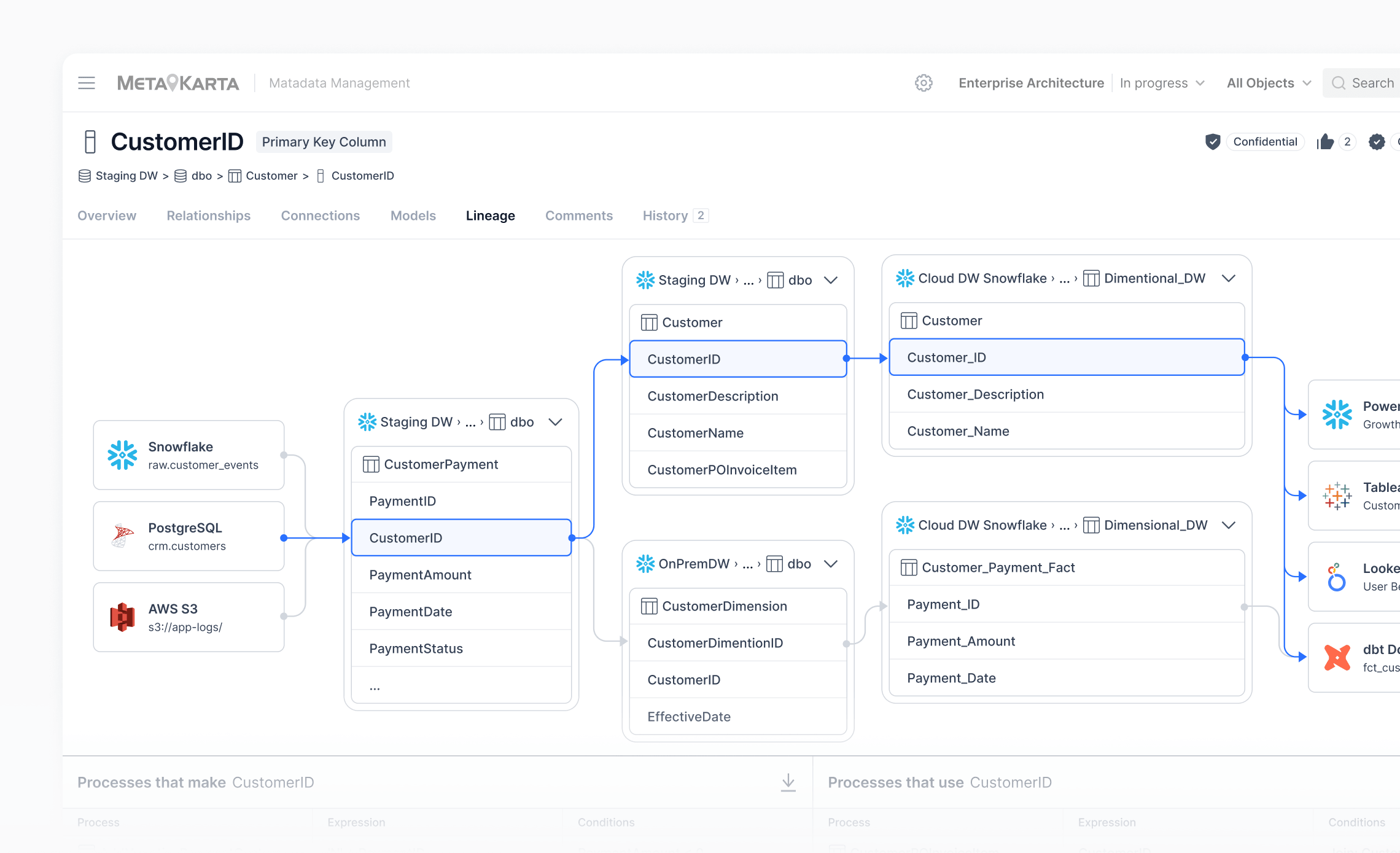

Every metric is traceable on demand at the column level
Lineage runs from source through transformation to AI output
Full version and configuration management supports audit answers
Data Catalog makes every asset in the estate documented, discoverable, and trusted, with profiling, semantic discovery, and social curation built in. Every entry carries its source, its owner, and its lineage, so context arrives ready to defend itself. And because the data catalog reads from the same shared repository as lineage, governance, and semantics, it stays current with the systems it documents. The catalog can't drift from the estate it describes.
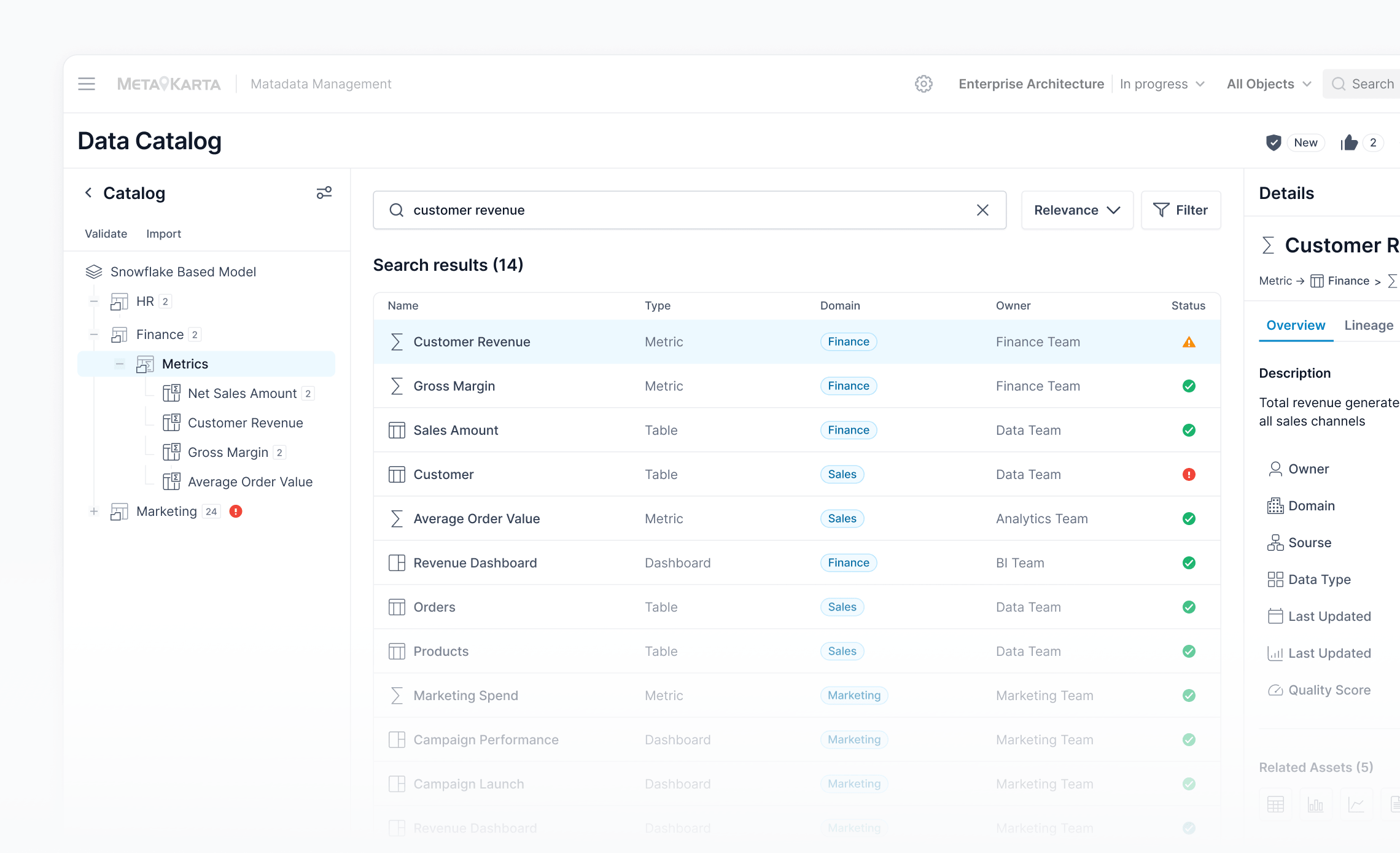
Definitions are findable with lineage attached
Agents and humans share the same governed context
Ownership and meaning are documented and available to business users
Define policy once and let the platform carry it. Stewardship workflows assign ownership and accountability, automated classification finds PII and sensitive data at scale, and access controls compile into the systems where data is actually used. Every governance decision is versioned, so you can answer what a policy said, who changed it, and when. Policy applied where the data is used, versioned where it changed.
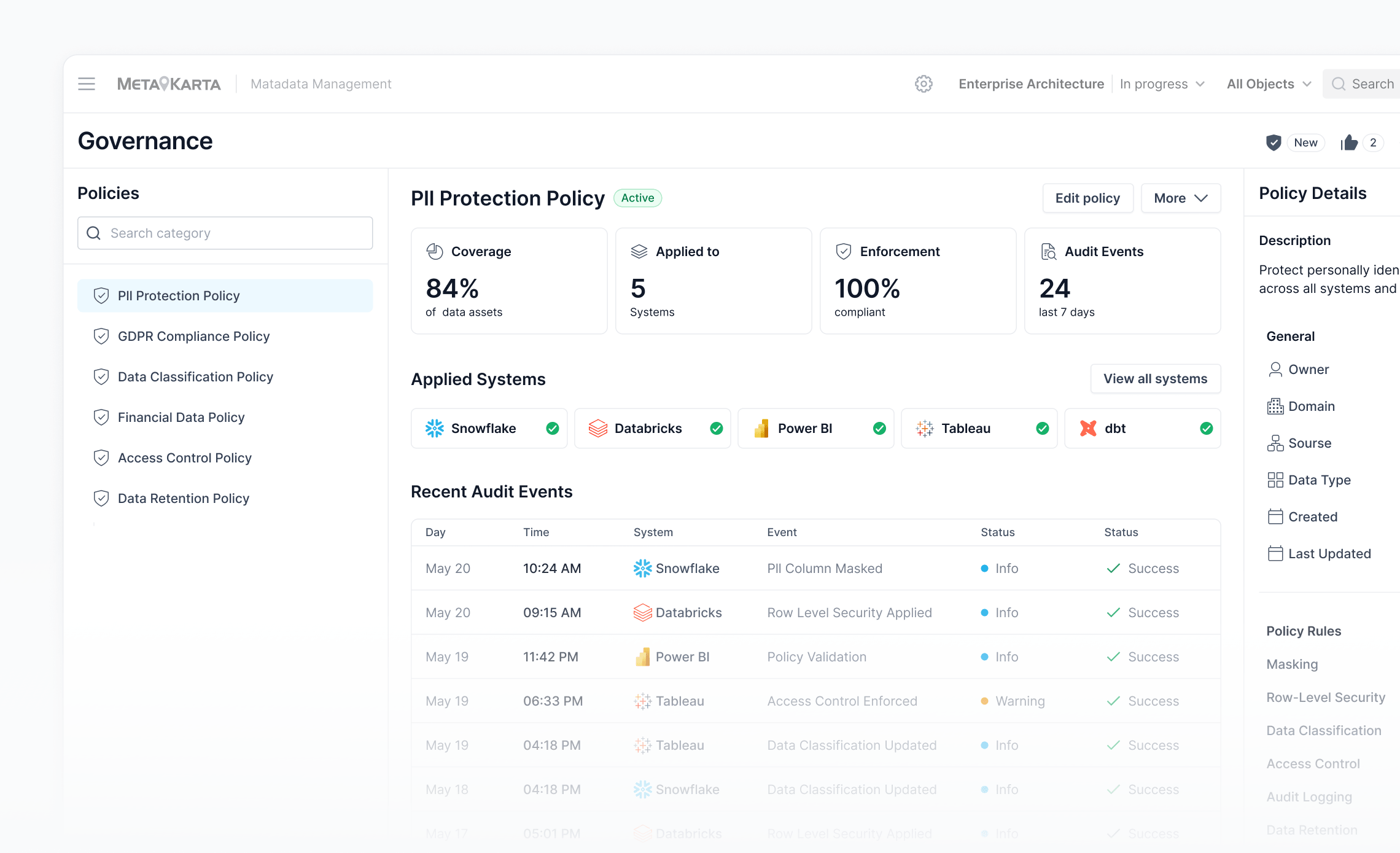
Stewardship assigns ownership and accountability
Policy travels with the definition into an AI agent's context
Version history, policy, and audit trail live in one view
Define business logic once and compile it into the native formats of the systems that consume it: Snowflake Semantic Views, Databricks Metric Views, Power BI semantic models, Tableau data sources, and more. The compiled artifacts are native and customer-owned, with no proprietary run-time dependency. AI agents ground on the same compiled definitions your BI tools run, so the same question gets the same answer everywhere. We don't sit in your query path. We've already compiled into your database and tools.
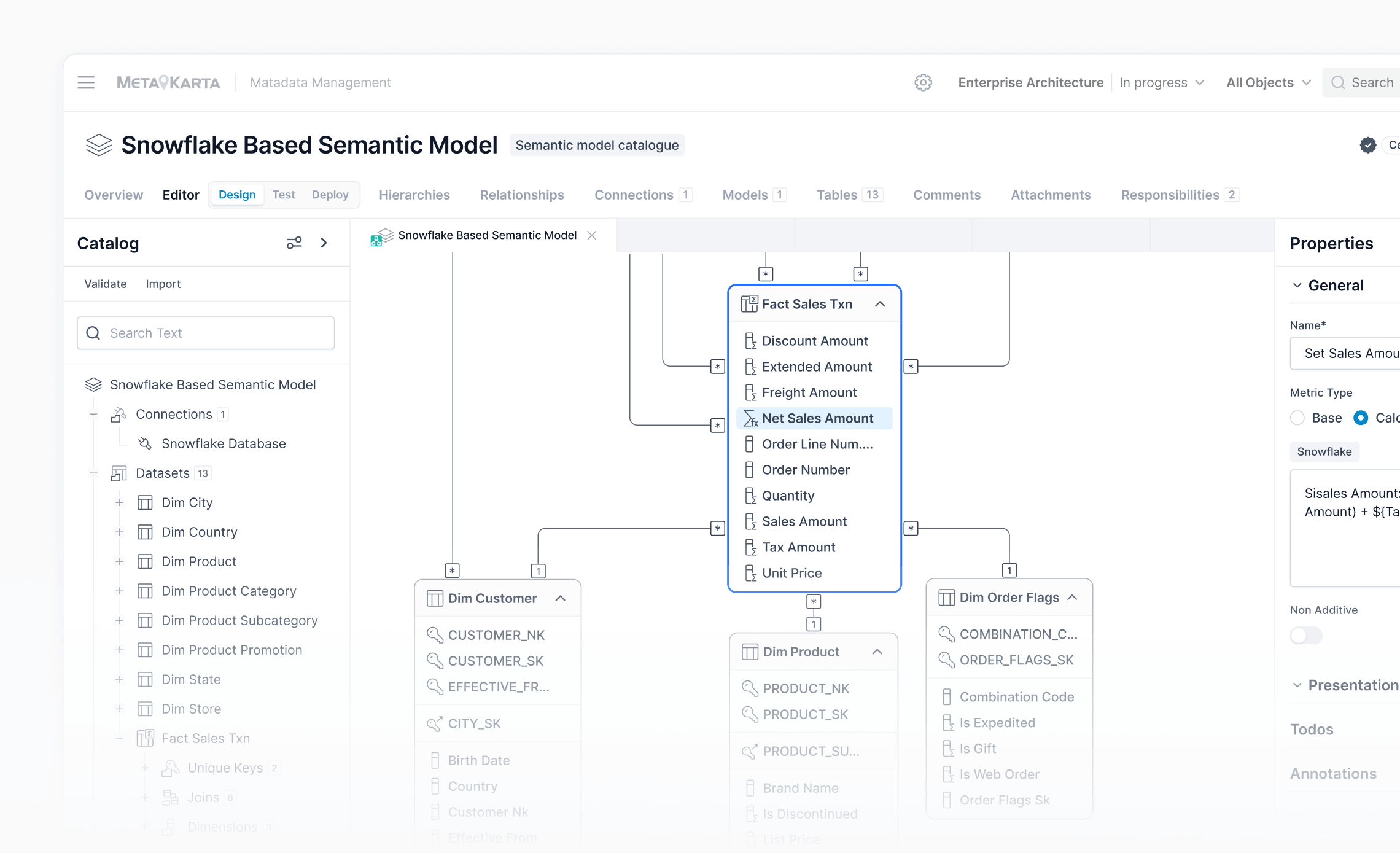
Portable, customer-owned native artifacts are deployed to targets
Definitions are native in an AI agent's grounding context
The enforced definition is the audited definition
“Knowing exactly where a number comes from, how it was transformed, and what it means in each system is a hard requirement for a regulated insurance environment. MetaKarta gives our teams traceability across the entire chain, and it works at the design level, not just at runtime. That’s what makes it defensible.”
MetaKarta is built on a single shared metadata repository, with built-in metadata version and configuration management. Lineage, catalog, governance, and semantics all operate from a single foundation, against the same data, with no reconciliation required among them. With 400+ connectors, no source in your estate sits outside it.

Gain complete visibility into your data estate: where it lives, where it flows, and what depends on it, before a ticket is logged.
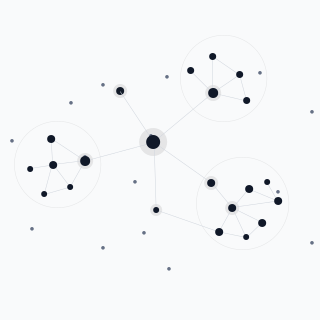
Connect business meaning to technical reality, defining what data should mean, who owns it, and how it should be used.
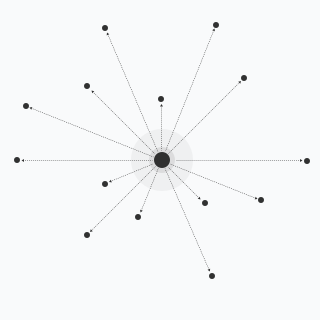
Compile governed definitions into the tools that consume data, so that what governance says is what systems actually do.
MetaKarta is built by Meta Integration Technology, Inc., the company that has provided OEM metadata connectivity to the world's leading data platforms for nearly 30 years. Now, the same engine is available to enterprise data teams directly as a complete platform: 400+ connectors, multi-architecture support, and parser-based column-level lineage proven at petabyte scale in the most demanding enterprise environments on the market.









Every data team fields the same hard questions from the business. MetaKarta answers each of them from one shared foundation: governed definitions, compiled into the tools where the question comes up
MetaKarta establishes the shared metadata foundation organizations have been trying to patch together for years: trusted BI, reliable AI, and defensible governance, compiled into every architecture, every cloud, and every tool. No runtime dependency. No vendor lock-in. No greenfield start required.


MetaKarta is a Metadata Management Platform from Meta Integration Technology, Inc. It connects data lineage, data catalog, and data governance on one shared metadata repository, and compiles governed business definitions into the native formats of databases, BI tools, and AI agents. The platform is built on nearly 30 years of OEM metadata technology embedded in products from Microsoft Purview, Informatica from Salesforce, Oracle, IBM, and Qlik Talend.
MetaKarta connects to your existing estate through 400+ connectors covering legacy and modern systems, on-premises and cloud. It harvests metadata from the tools you already run, then compiles governed definitions back into them natively. Nothing sits in your query path and there's no runtime dependency, so current workflows keep working exactly as they do today.
No. MetaKarta integrates with the databases, pipelines, and BI tools you already have deployed, and value starts with the estate as it stands. Many teams do consolidate point tools for lineage, cataloging, or governance over time, since those functions run on MetaKarta's shared repository, but displacement is optional.
MetaKarta delivers governed business definitions, relationships, policies, and provenance to AI systems. Agents query through structured consumption in Snowflake Cortex Analyst and Databricks Genie, or connect via MetaKarta MCP, and each answer comes back with the supporting compiled context behind it. Column-level lineage provides an auditable provenance chain from data source through transformation to output, ready for emerging AI governance mandates.
MetaKarta includes a full data catalog and goes further: it compiles governed definitions into the systems that consume data. Documentation describes what should be true. Compilation makes it true. That's the difference between recording a definition and enforcing it.
Most teams start delivering value within weeks. MetaKarta deploys alongside existing systems and harvests metadata through connectors, so initial lineage and catalog coverage lands quickly, with scope growing from there. Full enterprise rollouts vary with the complexity of the estate.
Yes. MetaKarta runs as hosted SaaS, self-hosted in your own cloud, or entirely on-premises within your own infrastructure, providing feature parity across all 3 deployment models.