Revenue in the warehouse says one thing. Revenue in Power BI says another. The dbt model carries a third opinion, and the AI agent someone wired up last quarter resolves against raw schema and invents a fourth.
The run-time semantic layer solved a real problem, for a specific architectural moment. One central place to define revenue, margin, active customer, with every BI tool querying through the layer.
Consistent answers, enforced at the query path. For organizations with a manageable stack and a single authoritative layer, it worked.
That moment has passed. The average enterprise data estate now has multiple semantic layers competing for authority: one in the warehouse, others baked into the BI platform, one the analytics team built in dbt, and one wired up for the AI agent POC.
Each was authoritative when it was built. None of them know the others exist.
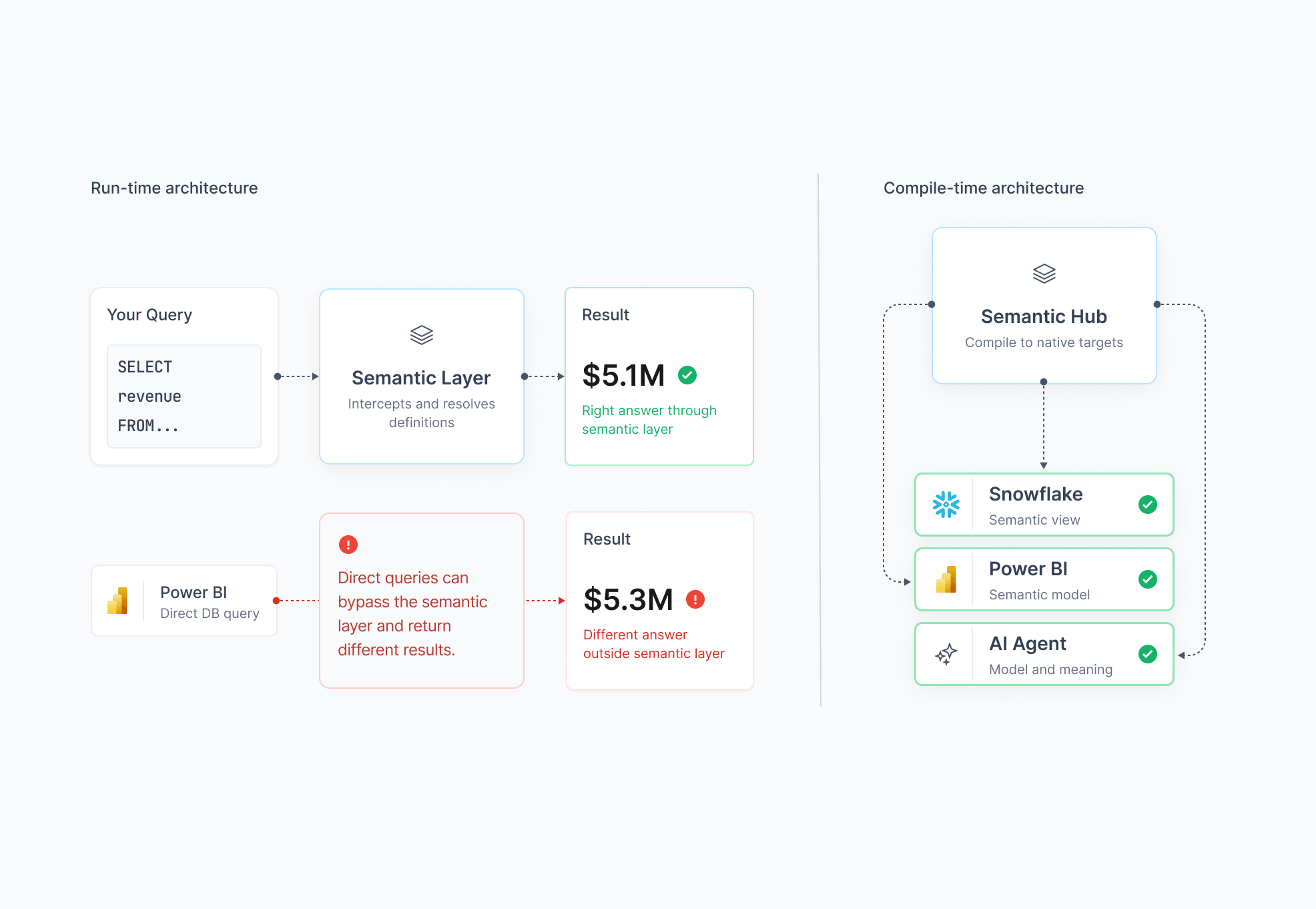
Run-time architecture intercepts queries. Compile-time architecture resolves the definition problem before any query runs. That distinction determines what a platform can structurally do, whatever its feature list claims.
Metric logic compiles into the database itself
Run-time middleware in the query path enforces a definition by intercepting the query, resolving it against a central model, and returning a result. Clean architecture when there's one path. Fragile when there are many.
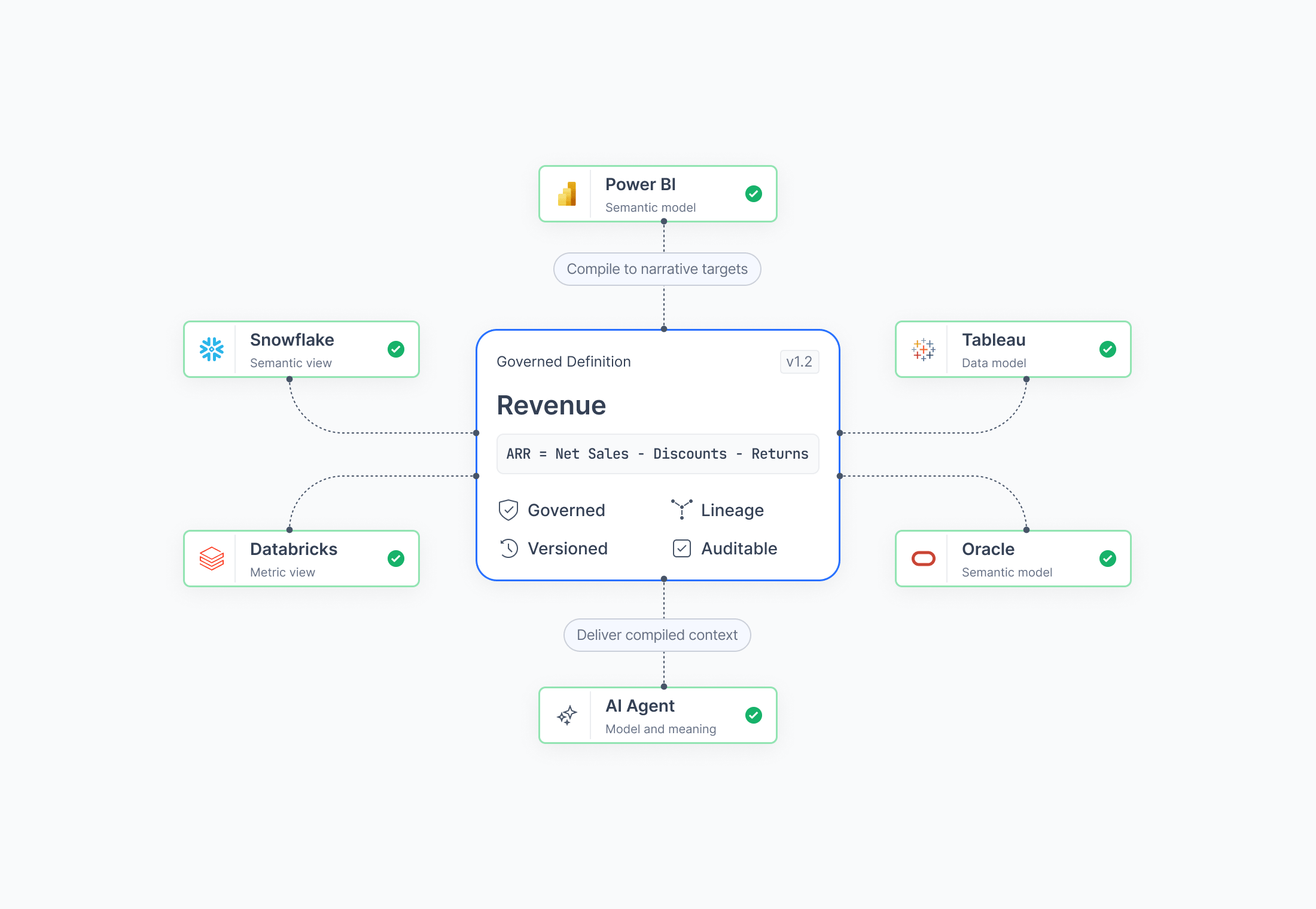
Compile-time architecture takes the definition out of the query path entirely. Semantic Hub, MetaKarta's semantic compiler capability, writes metric logic directly into database-native objects. The definition is already inside the database before the first query runs.
Each platform receives its governed definition as a native artifact, such as Snowflake Semantic Views or Databricks Metric Views. No new runtime, no added latency, no proprietary engine sitting in the path as a single point of failure. The metric lives where it's consumed.
Every BI tool reads the same governed definition
The BI metric consistency problem is a definition duplication problem. Revenue in Power BI drifts from revenue in Tableau because each team maintains its own model. The quarterly reconciliation exercise exists because there's no structural mechanism to prevent drift.
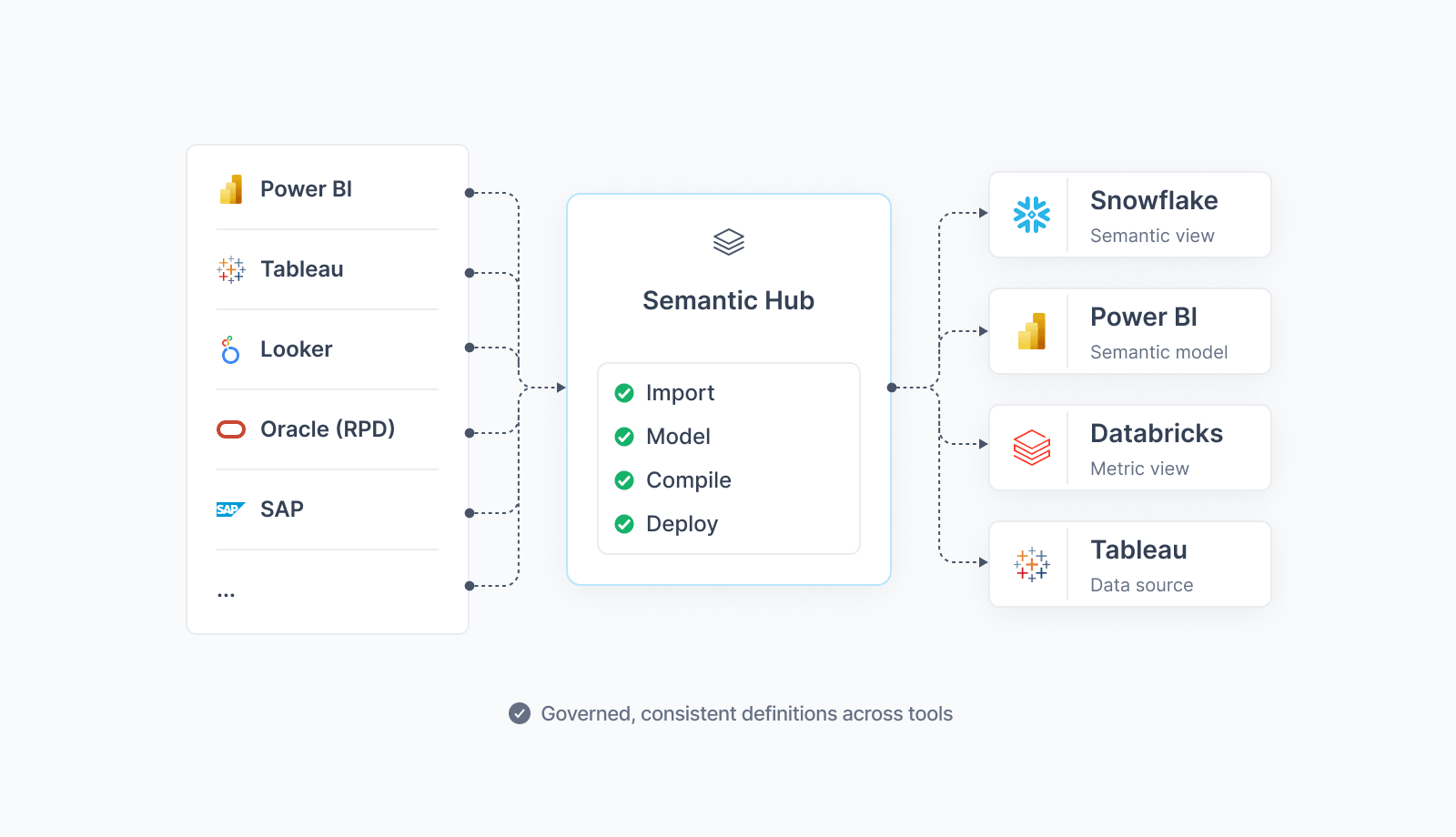
BI compilation resolves this structurally, ahead of policy. When a metric is approved, Semantic Hub compiles and deploys native artifacts for every BI platform in scope: Power BI semantic models, Tableau data sources, and more. Each tool receives the same governed definition in its own native format.
There's no middleware maintaining consistency at query time. The definition was compiled into each tool before the first query ran. Write once, compile anywhere.
Your existing semantic logic is the starting point
The standard assumption about metadata modernization: you start from scratch. Define everything in the new system, migrate over time, accept that the first year is mostly groundwork. For large enterprises with years of semantic investment embedded across Power BI workbooks, Tableau dashboards, Oracle RPD models, and SAP configurations, that assumption makes the migration feel impossible before it starts.
Semantic Hub's Import phase changes the starting point. It reverse-engineers existing assets, extracts the semantic logic they contain, enabling you to reconcile conflicting definitions and consolidate them into a single governed model. Expression conversion converts calculations from each platform's language into optimized native SQL, using MetaKarta's built-in conversion technology, AI-assisted only where needed.
The semantic investment you've already made becomes the raw material for the governed model. The groundwork year is already sitting in your BI estate.
AI agents ground in the definitions you already govern
Most enterprise AI implementations carry a quiet governance problem: the text-to-SQL agent and the executive dashboard resolve against different definitions. The agent reads raw schema. The dashboard reads a governed metric. The answers can and do diverge, and when they diverge in a context that matters, there's no clean way to explain why.
The architectural cause is that run-time grounding happens at query time, against whatever schema the agent was pointed at during setup. Compile-time grounding happens before the query runs. MetaKarta compiles business context (definitions, synonyms, security rules, valid values) that AI agents query against. Snowflake Cortex Analyst, Databricks Genie, and any agent connected through MetaKarta MCP's Semantic Hub Tools all receive the same compiled context that feeds the executive dashboard.
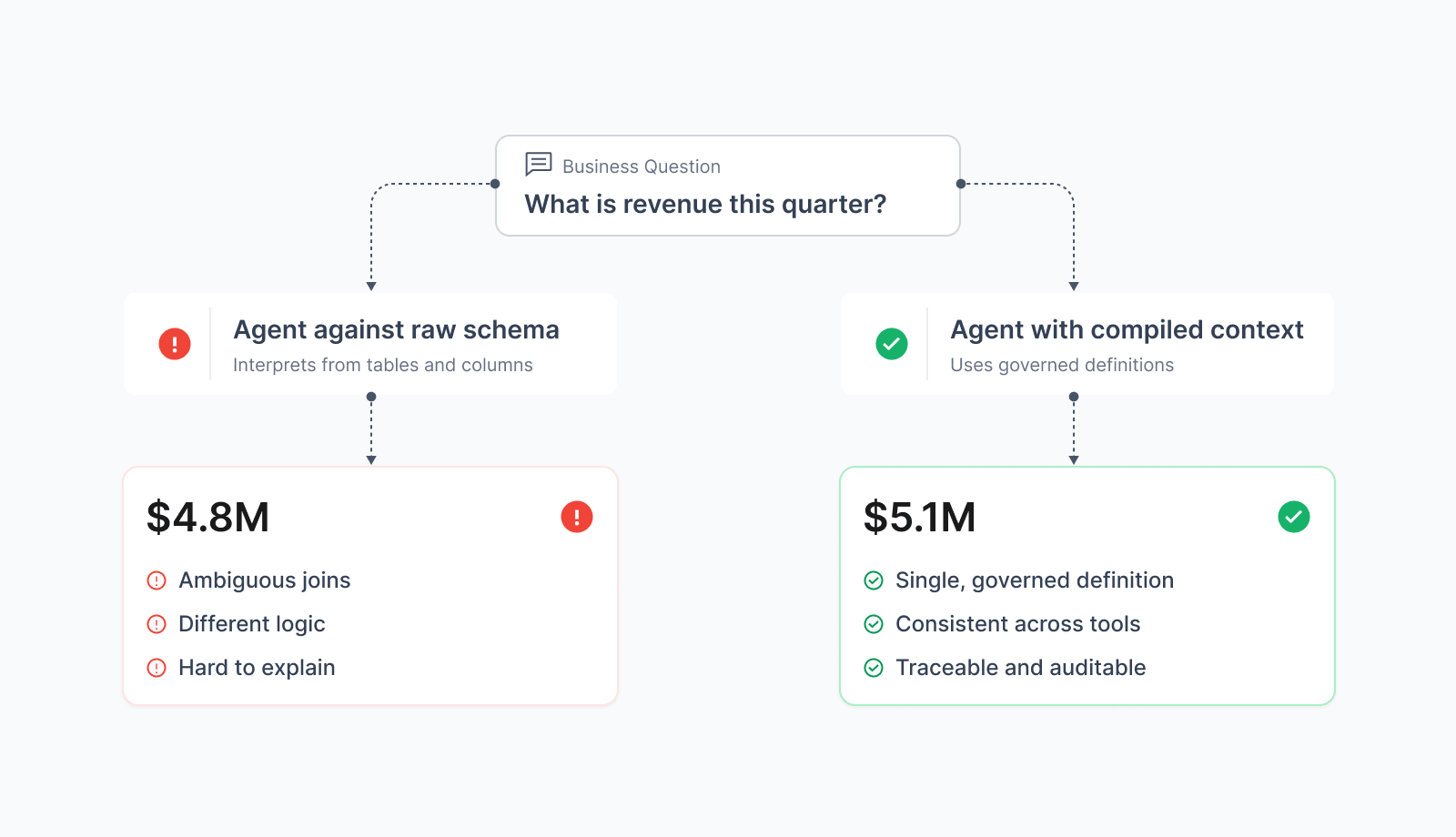
The governed definition is already compiled into the agent's grounding, so "revenue" arrives defined, with its business vocabulary wired in. And you can verify it before production. Context Sandbox runs representative business questions against the compiled context and shows which definitions, relationships, and physical assets produced each answer. You get the same answer across AI and BI.
Lineage holds up under audit
Audit readiness looks like a documentation problem until a regulator asks where a specific number in a specific filing came from. At that point it becomes an architecture problem, and the difference between "we have a catalog that documents this" and "we can trace this metric to its source column, through every transformation, with a complete version history" is the difference between a satisfactory answer and a findings letter.
Parser-based, column-level data lineage from MetaKarta traces any metric in any dashboard back through semantic definitions and transformations to the raw source column. Impact analysis runs before the schema change lands, while the fix is still cheap. Root cause analysis is available when a metric shows an unexpected value.
Every definition carries a version history, a change attribution log, and Git and CI/CD integration. SOX audit trails, CSRD lineage, ISSB reporting requirements, and the AI governance mandates stacking up behind them all demand this kind of provenance. Compliance-grade auditability is what the architecture produces by default.
Architecture sets the boundary
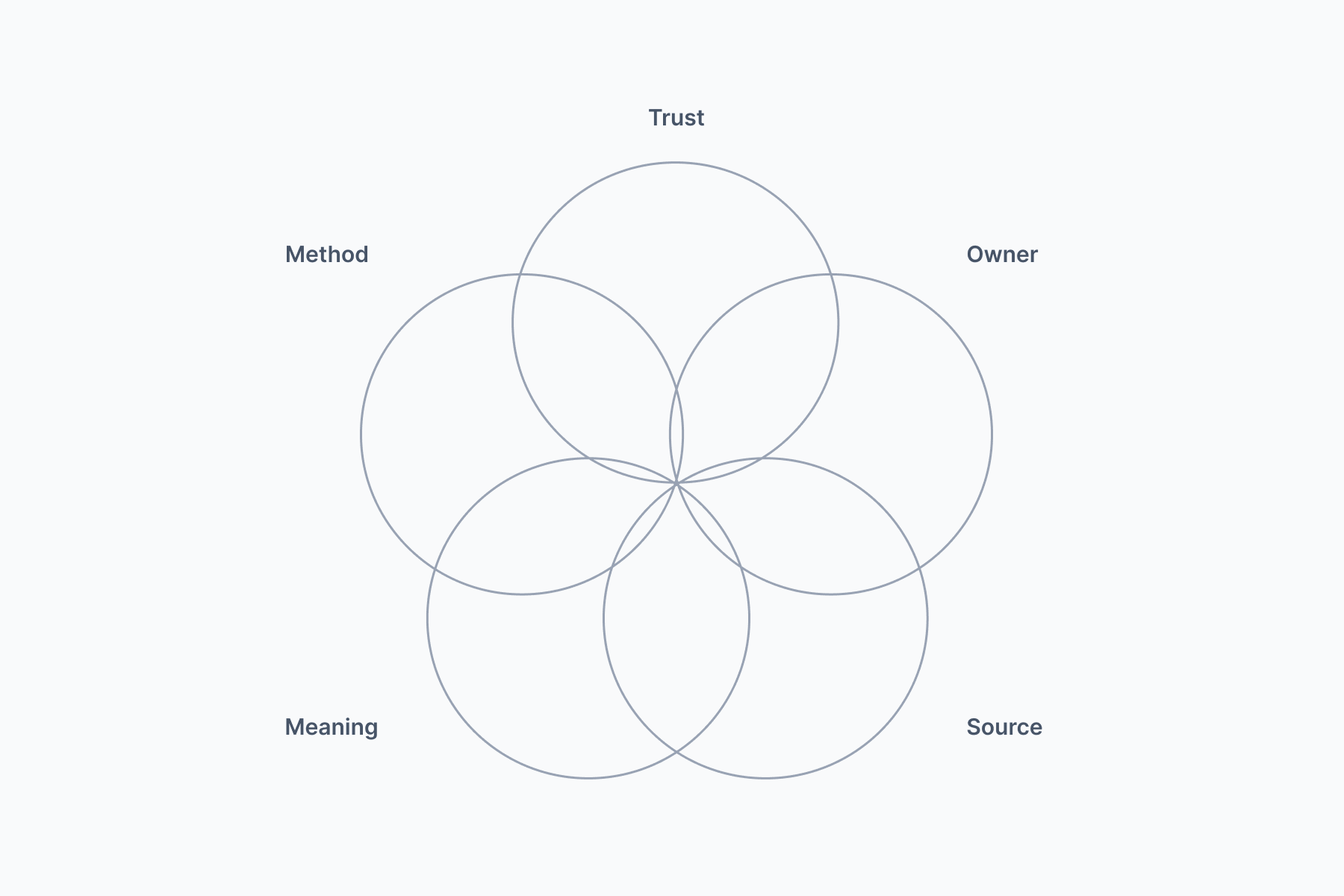
Each of these five capabilities shares the same origin. Compile-time execution makes them possible. Run-time execution puts them structurally out of reach, whatever the feature roadmap promises, because a platform that sits in the query path can't write native database artifacts, can't populate BI tools without a standing run-time dependency, and can't trace lineage from the point of authorship, since it was never present at authorship.
We don't sit in your query path. We've already compiled into your database and tools. Get in touch to watch a metric compile into Snowflake and Power BI in the same session, then return the same answer with MetaKarta MCP.