Two teams pull revenue for the same quarter. Finance reads it out of Power BI. Sales reads it out of Tableau. The numbers don't match, and the meeting stops while three people go find out why.
It's been survivable because a person sat in the middle of it. Someone noticed the gap, traced it back to two versions of the same metric coded by two teams who never compared notes, and fixed the deck before it reached the board.
Now an agent answers the same question. It reads whatever definition sits nearest the data, composes a query, and returns a number to whoever asked. Then it answers the next one, at machine speed.
The analyst was the verification step
An analyst who's spent years with the data develops instinct. They know which number tends to drift, which system reports it first, and who actually owns the definition when two dashboards disagree.
Instinct caught the mismatch before it reached the board. It was never written into a system. It just lived in one person's head, applied case by case.
That worked while the consumer of context was a person, because the person was the check. Agents remove the check. So verification has to move into the architecture itself.
MetaKarta v12 puts it there. Business meaning becomes something you can inspect when it's defined, test before it reaches production, and audit after every answer it produces.
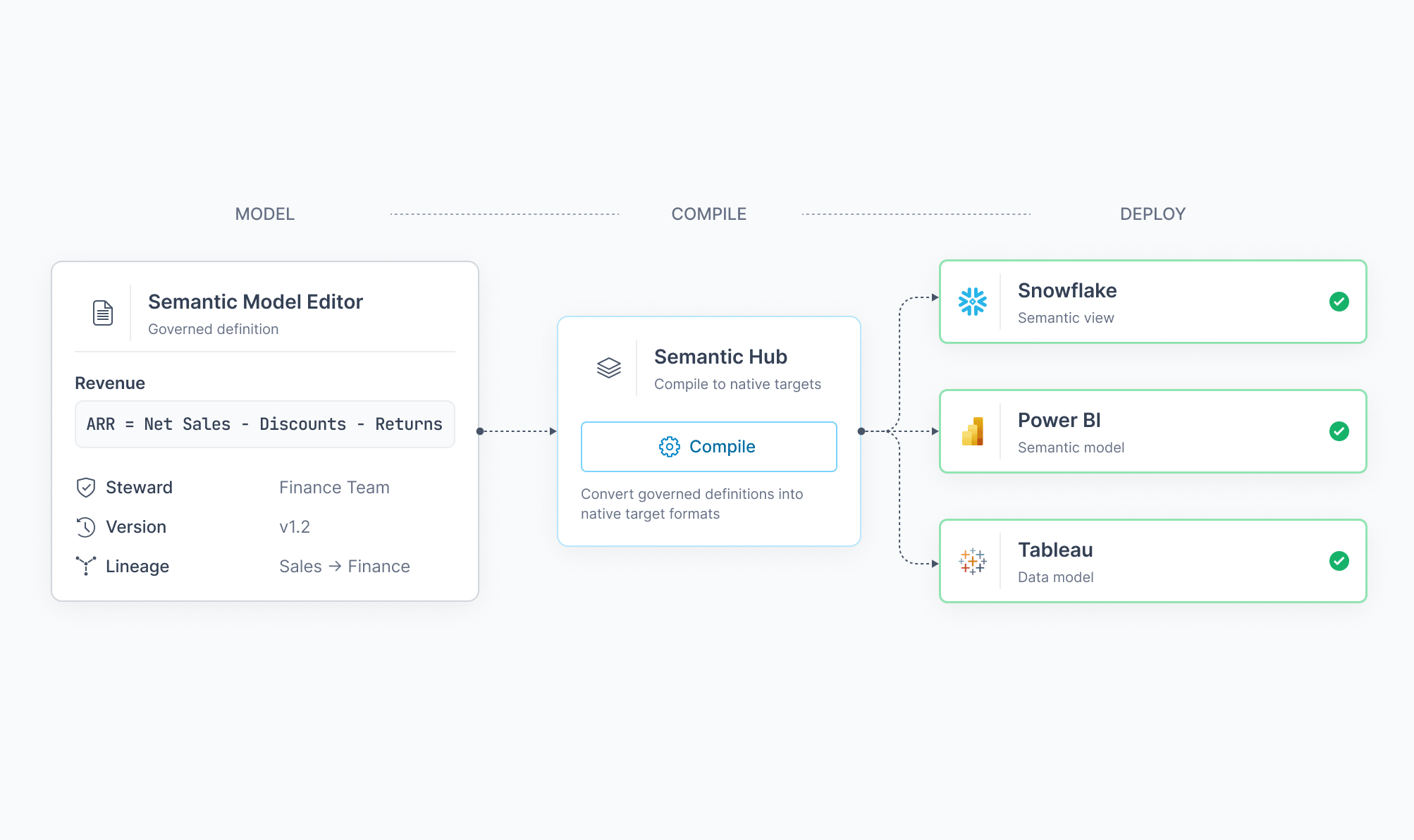
Write once, compile anywhere
Semantic Hub is the newest capability in the MetaKarta platform, joining Data Lineage, Data Catalog, and Data Governance. All four capabilities read from and write to the shared metadata repository.
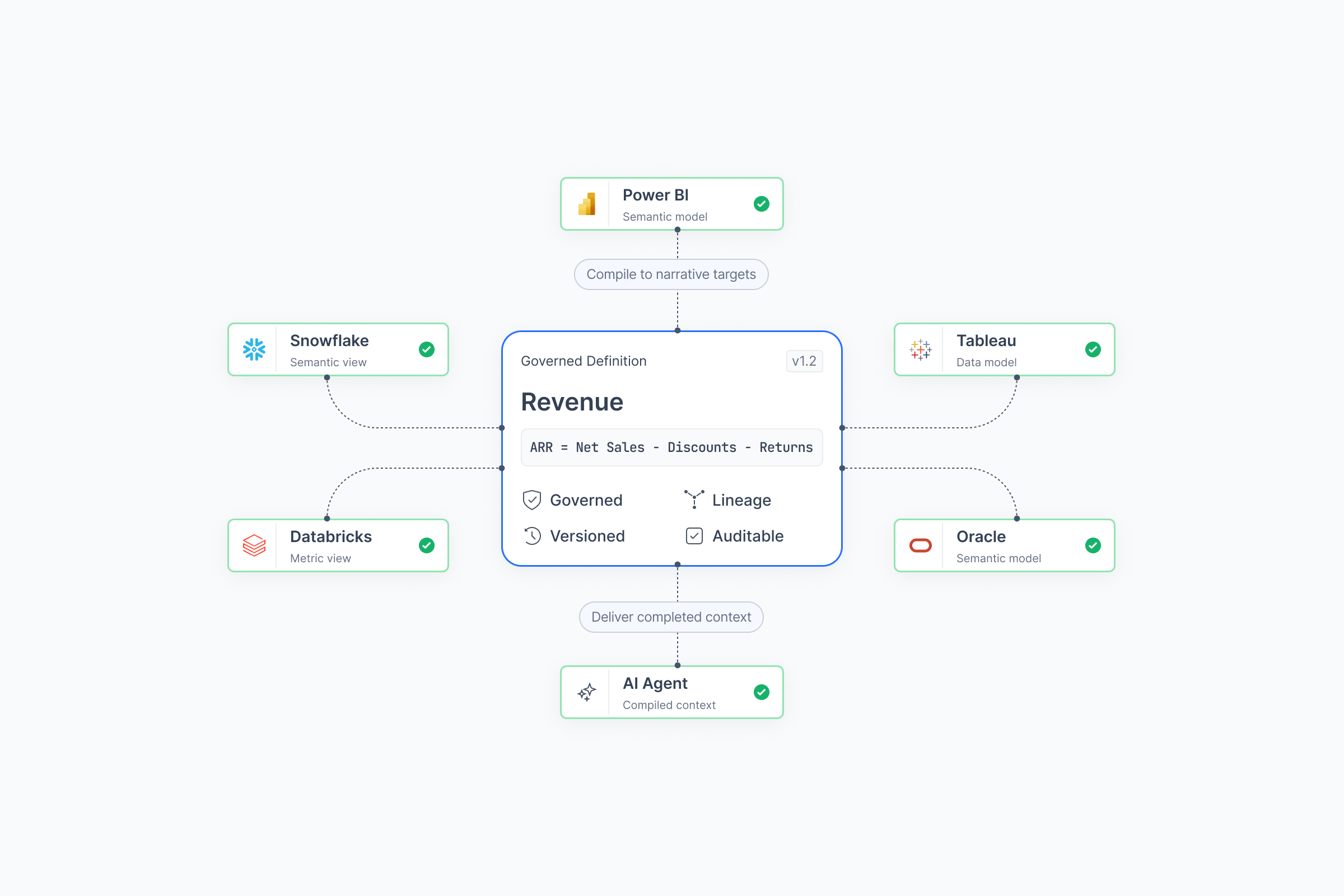
You design a semantic model, bind it to your business vocabulary, then compile and deploy it. What lands is a native artifact in each target database and BI tool, such as Snowflake Semantic Views or Databricks Metric Views and Power BI semantic models, Tableau data models, and LookML.
The compiled definitions are in place before any query runs. MetaKarta doesn't sit in your query path. It’s already compiled models and meaning into your databases and tools. Remove MetaKarta tomorrow and the artifacts stay where they are, working.
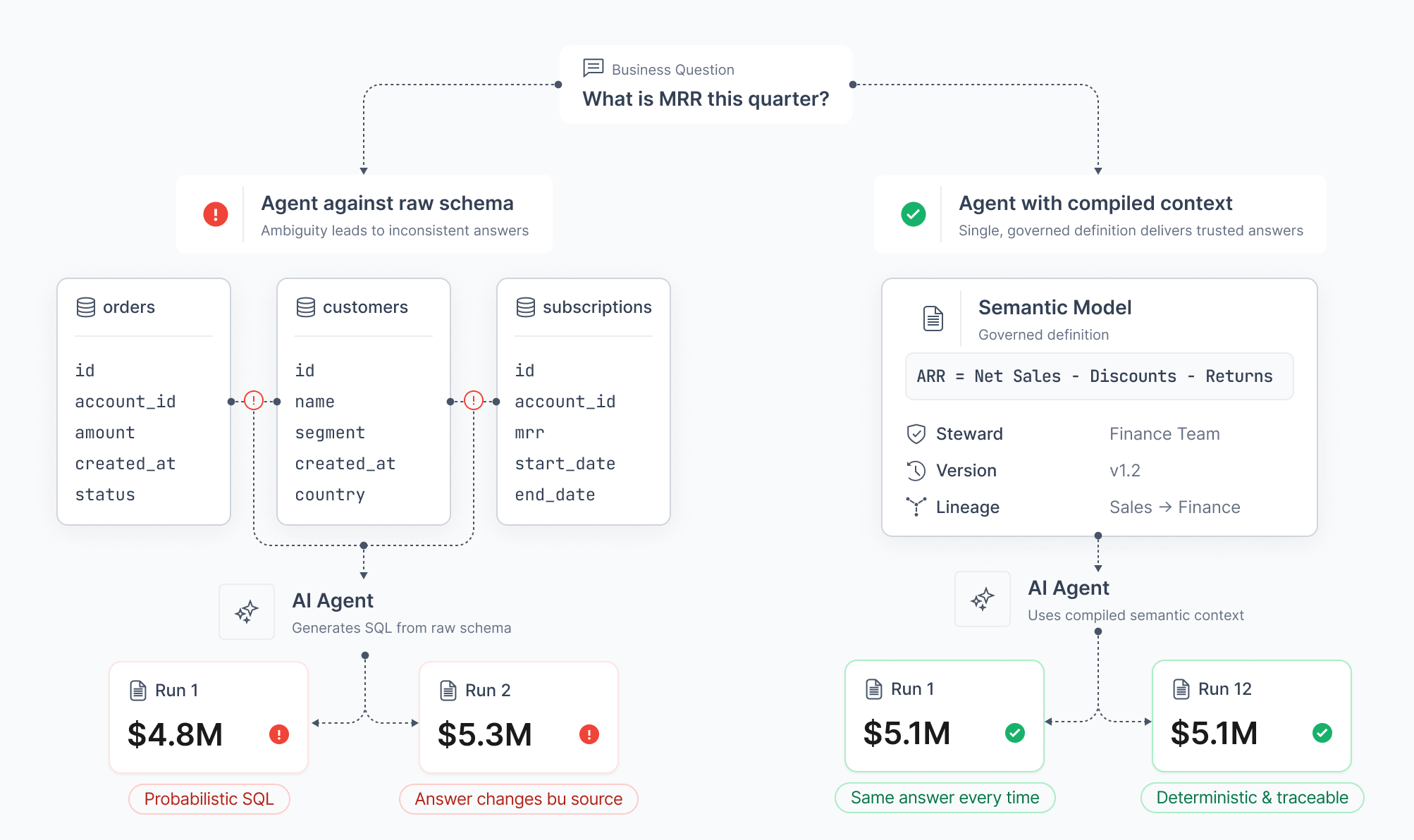
Agents receive compiled context
An agent pointed at raw schema has to infer what a metric means from column names and whatever else it can reason its way to. Inference upon inconsistencies across systems causes probabilistic outputs, depending on which system the agent reached first. The trust problem in enterprise AI is really a metadata problem.
Compiled context removes the inference. The agent receives the canonical definition of monthly recurring revenue, the relationships behind it, and the provenance that produced it, from the same semantic model the finance dashboard reads. You get the same deterministic, traceable, and provable output for AI and the same answer in BI tools too.
That determinism is also cheaper without a compute tax or a token tax. Serving an agent raw context makes it pay twice: compute to traverse a graph and assemble meaning, then tokens to generate probabilistic SQL, then another round when the answer comes back wrong.
Metadata management becomes a continuous operation
Your data estate doesn't stand still. A source lands, a transformation gets rewritten, a definition gets revised, and an agent starts asking questions the original model was never designed to answer.
We call the discipline MetadataOps: metadata work that runs as a continuous enterprise operation across data lineage, data catalog, data governance, and semantics. Definitions get versioned, reviewed, and deployed with the same rigor engineering teams already apply to code.
v12 gives that practice somewhere to run. All four capabilities read from and write to the shared metadata foundation, so a definition revised once reaches every downstream system that depends on it, agents included.
The MetadataOps Kit covers the practice itself: the operating lifecycle, a metadata quality scoring model, and a paste-ready job description and skills matrix for the MetadataOps Engineer role.
What's inside MetaKarta v12
- Semantic Hub. Reverse-engineer existing semantic assets from Power BI, Tableau, Looker, MicroStrategy, SAP BusinessObjects, IBM Cognos, and Oracle OBIEE, govern them centrally, then compile them into native artifacts. View documentation
- Semantic Hub Language (SHL). A YAML-based language for defining semantic models.
- Ontology Modeling. Define business entities, relationships, and hierarchies as a governed ontology, bound to the semantic models and physical columns that implement them. Every concept is bound to a real asset from day 1. View documentation
- MetaKarta MCP. One server, two toolsets. Metadata Management Tools serve governed metadata; Semantic Hub Tools serve compiled context. Per-user access tokens mean an agent sees exactly what the person behind it is authorized to see. View documentation
- Context Sandbox. Run a real business question against your governed context and inspect the grounding before anything reaches production. View documentation
- Ask MetaKarta. Natural-language access to governed metadata, through your LLM provider of choice, with lineage and policy attached to every answer. View documentation
Plus a rebuilt interface: consolidated navigation, a larger workspace, and harmonized dialogs, panels, and object browsers.
Unified enterprise metadata management
MetaKarta is built to address the complexity of today’s enterprise data estates that span legacy on-premises platforms to modern cloud data and BI platforms. With Semantic Hub, the expanded metadata management platform delivers:
- Trusted BI: Every BI tool reads the same compiled artifact, so the number is the same number in each of them.
- Reliable AI: An agent reads the same governed context every other consumer reads, validated in Context Sandbox before the agent ever saw it.
- Defensible Governance: Every definition has an owner, a version history, and a policy compiled alongside it.
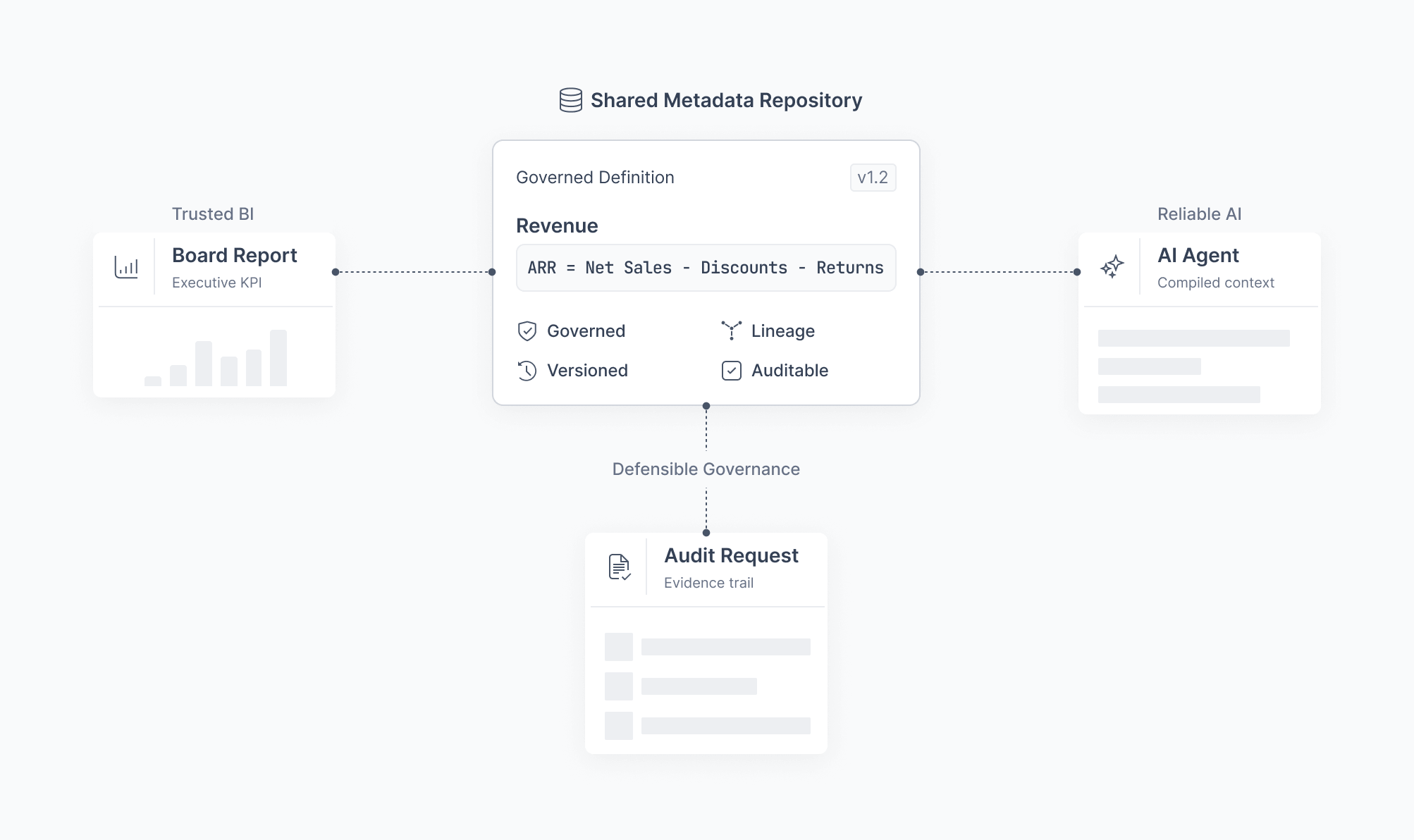
Prove every number
Meta Integration Technology has built OEM metadata infrastructure for nearly 30 years, shipping inside products from Microsoft Purview, Informatica from Salesforce, IBM, Oracle, and Qlik Talend. That's where the 400+ native connectors and the parser-based, column-level lineage come from. Vendor-neutral by architecture, not by promise.
MetaKarta gives you the artifacts to prove every number, compiled into databases and BI tools while delivering compiled context to AI agents. Get in touch to learn more about the latest release.