Christian Bremeau
Founder & CEO
Connect with us

From data warehouses to AI, every technology wave depends on the same foundation.
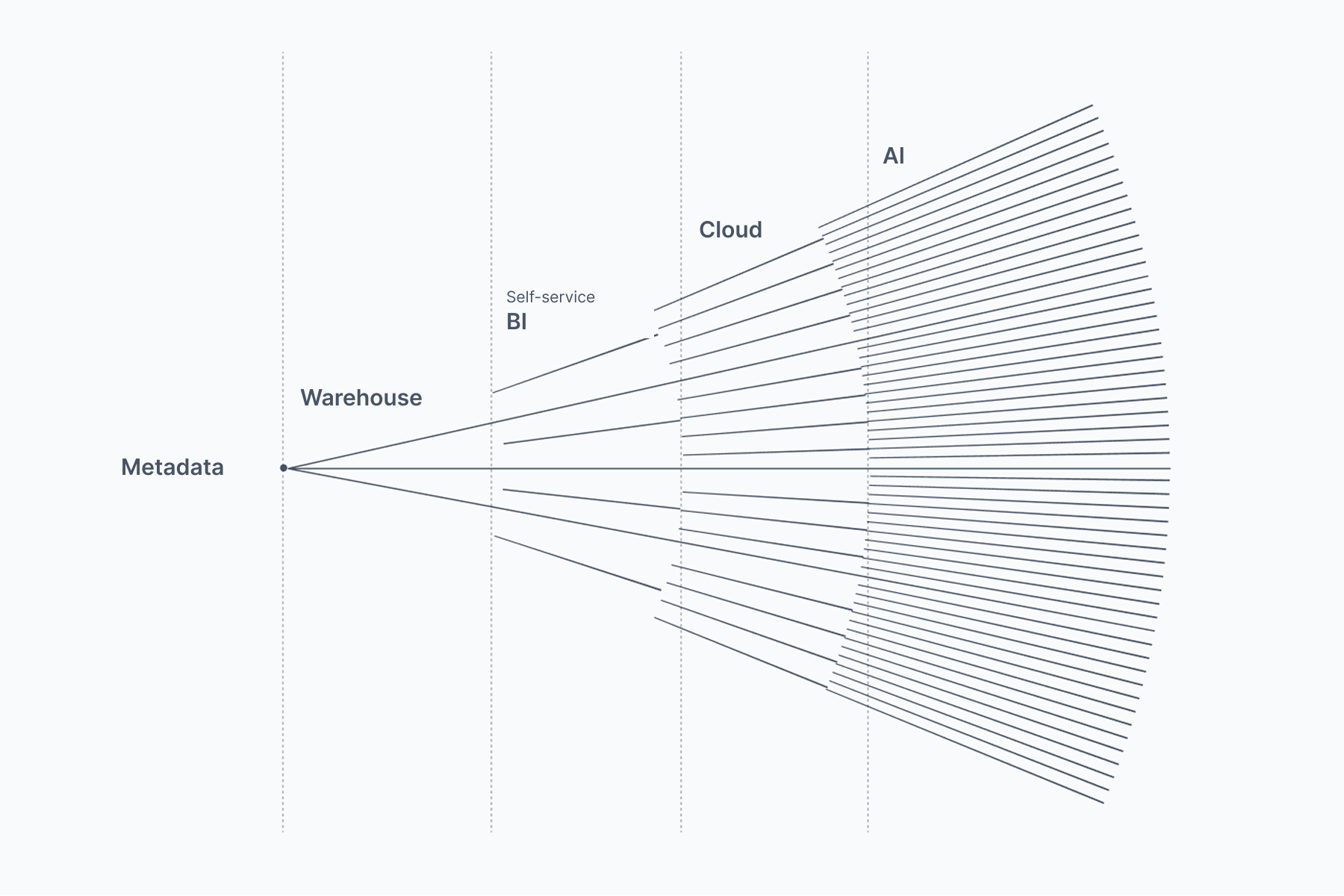
In nearly 30 years of watching enterprises adopt the next big thing in data, I've lost count of how many times the pitch was the same. Data warehousing was going to fix how the business used data, and so was self-service BI. So was the cloud, and now it's AI's turn.
Each wave changed how enterprises store data, analyze it, and act on it. None of them changed the question that actually determined whether the promise held: does the organization know what its data means, where it came from, and who can trust it? That’s metadata. It was the answer when I started Meta Integration Technology nearly 30 years ago, and it’s still the answer now.
In the 1990s and 2000s, the enterprise data warehouse was supposed to get every department working from the same numbers. It mostly did, for as long as someone maintained the definitions behind it by hand: what "revenue" meant, which system owned it, how it rolled up from source to report. Getting that right meant a glossary somebody kept current and a steward who fielded every disputed definition, and that manual work decided whether the promise held.
That work didn't get easier as the estate grew. More source systems meant more places a metric could quietly drift, and the glossary and the steward were expected to keep pace by hand, one spreadsheet row and one hallway conversation at a time. The people who carried that tribal knowledge eventually moved to new roles or new companies, and the definitions they'd kept straight went with them.
Tableau, Qlik, and Power BI put reporting in the hands of anyone who could drag a field, and that was genuinely good for the business. IT stopped being the bottleneck for getting an answer, and it also stopped being the checkpoint that reconciled competing definitions, and no one else picked that job up. Every new dashboard became a new chance for someone's alternate calculation to disagree with everyone else's.
A metric like "active customer" could carry three or four technically correct definitions depending on which team built which dashboard, each one right within its own tool and irreconcilable with the others. Enterprises tried to referee the mess with a catalog bolted on after the fact, cataloging what already existed instead of preventing the next disagreement from forming. By the time a discrepancy surfaced in a steering committee meeting, the conflicting dashboards had already shipped to hundreds of people.
Modern cloud platforms like Snowflake and Databricks solved storage and compute at a scale the warehouse era never touched, and did it well. Streaming data, semi-structured logs, and formats no 2005 warehouse schema was built to hold all landed in the same estate, compounding the same old question of what any of it meant. Metadata consistency across teams stayed a separate, harder problem underneath all that scale, and the estate got bigger and faster while that problem waited.
More teams could stand up a new pipeline or a new model without waiting on a central data team, which was the entire point of the shift. It also meant more places for a business definition to get typed in slightly differently, multiplied across teams that increasingly never talked to each other. The volume of new tables, models, and dashboards grew faster than anyone's ability to track what any of them actually meant.
An analyst who gets a bad number from a dashboard scrutinizes it, asks around, and catches it before it reaches the board. An agent that gets a bad definition acts on it at machine speed and ships the result. The stakes moved from a mismatched slide in a Tuesday meeting to a decision an auditor or a regulator will ask about later.
Gartner revived the Metadata Management Magic Quadrant in November 2025. Its return after five years is a strong signal that metadata management has moved back into the center of the enterprise data conversation, just as AI raises the cost of getting context wrong.
Across financial reporting, risk data, privacy, and emerging AI governance, organizations are being asked to show how definitions, controls, and decisions are applied in practice. Regulators are done accepting documentation as the answer on its own.
Meta Integration Technology has spent nearly 30 years building the metadata engine inside other companies' platforms like IBM, Informatica from Salesforce, Oracle, and later Microsoft Purview. That work meant reconciling metadata across systems that were never designed to agree with each other.
We were there for the warehouse era. We were there when self-service BI took off. We're still there now that AI is asking the same question, at a speed no analyst can supervise by hand.
That vantage point taught us one thing above the rest: the technology on top changes every few years. The metadata underneath is what decides whether any of it actually works.
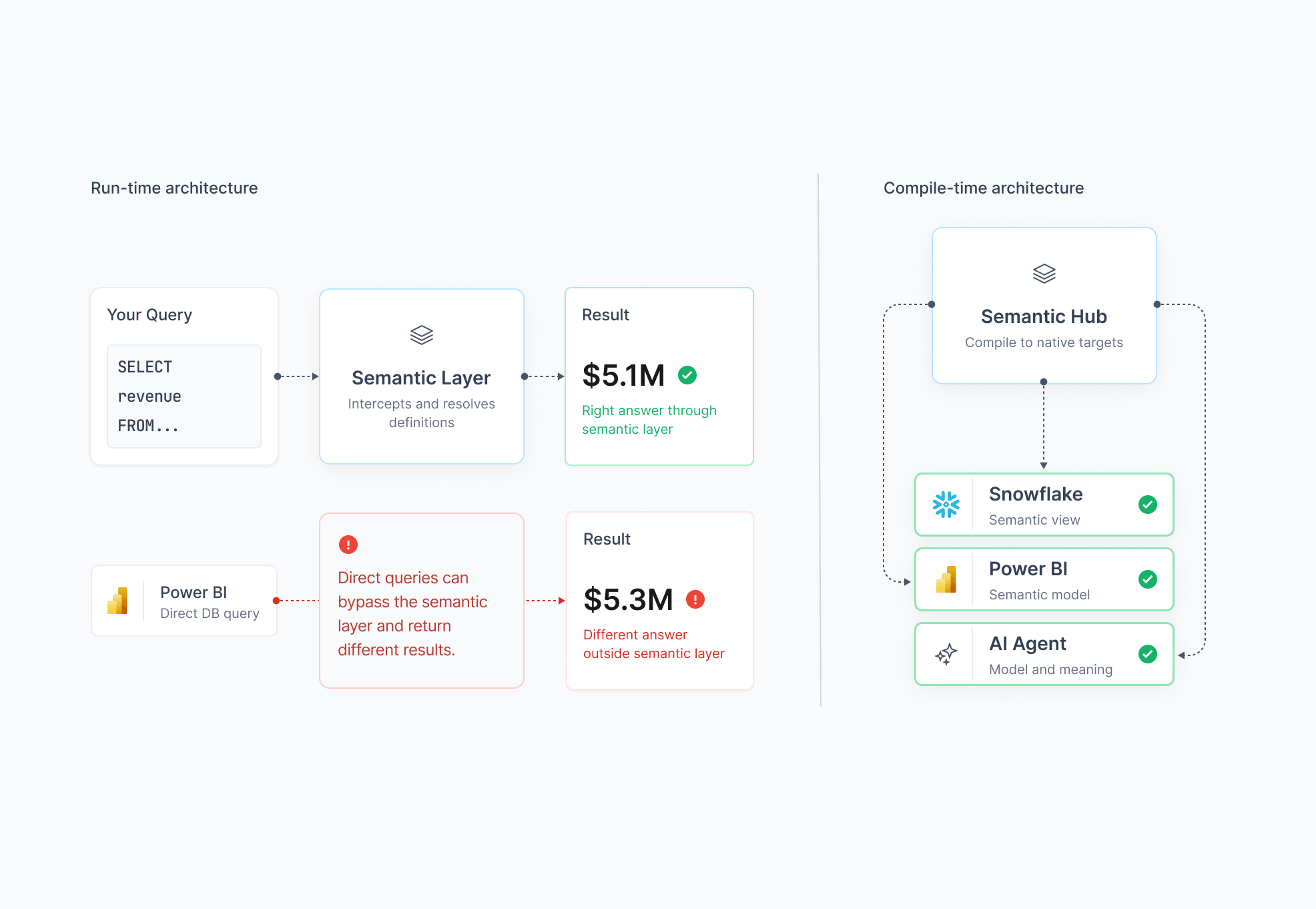
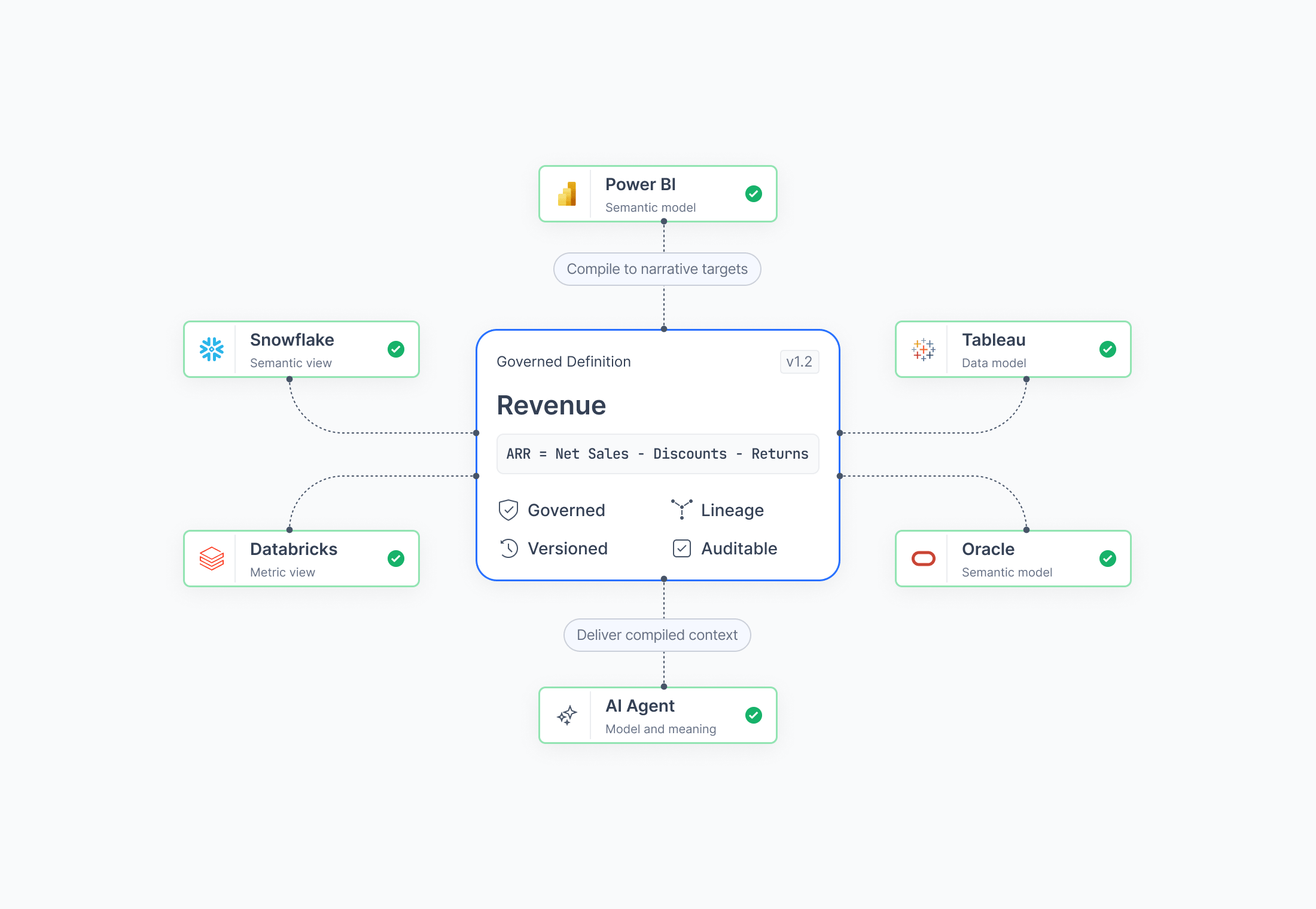
MetaKarta carries that lesson forward through one shared metadata foundation, spanning legacy on-premises systems and the modern cloud stack. The same definitions, lineage, ownership, and policies support every system that reports a number, every agent that acts on one, and every audit that has to explain it later.
For reporting, that means a number can be traced to its source and governed consistently across databases and BI tools. For AI, it means agents receive compiled context tied to real data assets and visible evidence. For governance, it means every definition carries an owner, a version history, and a record of where it was applied.
Every wave since the 1990s asked the same starting question, and MetaKarta is built to answer it once, and keep answering it as the next wave arrives. Whatever comes after AI, it will ask the same question the warehouse asked back in the 1990s: what does your data actually mean, and can you prove it?
It all starts with metadata.